Toolbox — For Training and Youth Work
All new tools in your inbox: Be the first to know about new tools for learning with our e-mail notifications.
Simulation Exercise, Group Building Activity, Name Game/Get to know each other
Whispers and Lies – Mystery of the Cursed Village (Szepty i kłamstwa)
An educational social deduction game where eliminated players become ghosts who spread rumors. This unique mechanic creates a practical testing ground for youth to analyze trust, manipulation, and decision-making under information asymmetry.
Aims of the tool
To build civic resilience through critical thinking. The tool helps youth understand the "illusion of confidence," question authority, verify sources amidst information noise, separate facts from gut feelings, and critically analyze their own decision-making processes and cognitive biases.
Description of the tool
**The Mystery of the Cursed Village**
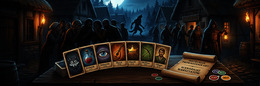
Imagine standing in front of a group, with the fate of a cursed village resting in your hands. This isn't just another ordinary round of a popular party game where players simply guess who is who. You are hosting "Whispers and Lies" – a powerful educational simulation that, under controlled conditions, exposes how easily we fall into echo chambers and succumb to manipulation. Your task as the Game Master (GM) is to weave a web of intrigue in which participants learn to distinguish hard facts from opinions. The game relies on a reward system in the form of ADDTRUTH stickers, which you award on an ongoing basis for analytical thinking and engagement, further motivating participants to make an effort.
Before the first night falls, you assign everyone a role in complete secrecy. Ordinary Villagers have no nocturnal abilities, but during the day they must gather information to eliminate the Werewolves. However, the true depth of this simulation lies in the special roles. There is the Seer, to whom you answer at night with gestures, pointing your thumb up or down, whether the person they are checking is on the side of evil. The village also has its Alchemist, who can protect one person from dying at the hands of the beasts each night. Crucially, the Alchemist possesses a unique "truth potion," which can be used only once during the entire game. When they do, you as the Game Master officially announce this fact in the morning (e.g., saying "The truth potion was used on..."), which becomes a hard piece of evidence in the investigation around which the villagers must build their argumentation. The group may also conceal a Sleepwalker, who risks their life by peeking at night, a Hunter who takes someone to the grave with them, and two people connected by a Mysterious Bond, where the death of one means an automatic game over for the other. Above all this, the Sheriff can openly keep watch, possessing as many as two votes during voting, which wonderfully teaches questioning authorities, especially when it turns out in the end that they were the hidden monster imposing a false narrative on the village.
When you announce the arrival of night, everyone closes their eyes, and a heavy, absolute silence must fall over the room. Soundlessly, you wake the Werewolves, who collectively and silently point out their victim, and then you call upon the other characters so they can make decisions about using their abilities. The biggest plot twist, however, occurs in the morning. Instead of a standard discussion in a large circle, you announce objective facts – for example, that two people died, or that someone was miraculously saved – and you open the "Strolls" phase, lasting about three minutes. Participants physically stand up, walk around the village, form small subgroups, spread rumors, and gather information, moving between the designated "Tavern" and the "Cemetery". During this time, players use the "Investigator's Notebook" (download here), in which they categorize the acquired knowledge based on a traffic light system: the green light represents your hard facts, yellow represents their own observations of others' behavior (e.g., who is talking to whom in secret), and red represents only overheard "stories," meaning opinions and unverified declarations.
It is precisely there, in the Cemetery, that the most innovative element of this simulation is revealed – the Spirit World. Eliminated players do not end their fun but become active Spirits, who can keep their eyes open at night and carefully observe everything. At the beginning of the Strolls, they hold a quick Spirit Council, deciding together whether their ultimate goal for the given round is to help the lost village or to deliberately introduce confusion and amplify the chaos. If there are between three and six spirits, they use the "Voice from the Beyond," whispering exactly one word-clue to a single player seeking knowledge. However, they are strictly forbidden from using names, role names, or simple "yes/no" answers, which forces creative encryption of messages. When seven or more Spirits gather, they can create a physical Letter from the Beyond – a drawing, symbol, or a phrase of up to three words – which they hand to you to present to the entire town. They also have powerful tools for direct interference: twice per game, they can induce Possession, which causes a selected living player to start acting irrationally and lose their vote, and once per entire game, they can use the Voice of Damnation, physically joining the accusation of a chosen person and creating a ghostly noise during the vote.
At the end of each day, the entire village meets in the main square for an open debate. Here, as the facilitator, you make sure that accusations are based on deduction from the Investigator's Notebook – players must know "why" they are accusing someone, and not rely on a vague gut feeling. The climax of the tension is the public voting by a show of hands. When emotions reach their zenith during the day, and the village gets lost in a thicket of yellow observations and red rumors, you, as the Game Master, have one more ace up your sleeve. You can sell them the pure, absolute truth, which will light up their Investigator's Notebooks in green and enter the canon of undeniable facts. Participants can ask you one single, open question, but this divine knowledge is not free – its cost will be ruthlessly deducted from the final prize pool (the value of which is decided by the GM depending on the significance of the answer in a given context) that they are fighting for. The catch, however, lies in the mechanics: to strike a deal with you, the living part of the village must make the decision absolutely unanimously.
And it is precisely at this moment that a fascinating new level of deduction opens up for the players. Someone just blocked the transaction? Excellent! Now the whole group must analyze this behavior. Is the opposing player a calculating monster trembling with fear because the asked question will expose their lies? Or maybe they are simply a rationally thinking villager who is absolutely certain of their conclusions and doesn't want to deplete the shared treasure before the finale? Every hesitation when raising a hand becomes another piece of evidence in the investigation at this point. The true finale of this workshop, however, is not the information about who won, but an in-depth Debriefing. This is the moment when emotions subside, participants symbolically step out of their roles, and together analyze the flawed decision-making process. You begin to uncover the "illusion of confidence," where the youth realize that they repeatedly supported someone just because that person shouted the loudest and sounded extremely confident. You discuss the critical verification of sources, exposing the fact that the magical hints from the Spirits could have been a hundred percent calculated lie, which teaches the verification of the sender's intentions. Thanks to this immersive story, young people gain real, practical tools for critical thinking, learning to separate facts from emotions.
**How does the simulation teach critical thinking?**
The "Whispers and Lies" game was designed to simulate, in controlled conditions, how people convince each other in the real world and on the internet. Below are the most important areas it affects:
* **Analysis of the decision-making process** – the final discussion teaches players to step outside the so-called filter bubble. Participants notice that they often get attached to one version of events and ignore alternatives. The most valuable lesson in critical thinking is that it's not about infallibility, but about the awareness of why we make a given decision and how we can argue for it.
* **The Illusion of Confidence** – the youth quickly realize that they have repeatedly trusted someone only because they spoke loudly and sounded incredibly confident. The simulation exposes the fact that the style of speech is not proof of being truthful.
* **Verification of sources in information noise** – information provided by Spirits or other characters can be a 100% lie. This teaches young people to verify not only the content of the message itself but also the intentions of the person it comes from.
* **Questioning authority** – the game features the Sheriff, who has a privileged position and two votes. However, the Sheriff himself may turn out to be a monster. This exercise perfectly illustrates the problem of blindly trusting people with power or a leadership role without hard evidence that they are right.
* **Separating facts from feelings** – instead of guessing based on vague feelings, the game forces and encourages asking good questions and basing accusations on specific statements or behaviors.
*Scenario created for the project 2025-3-PL01-ESC30-SOL-000369961 implemented as part of the European Solidarity Corps funded by the European Union.*
Available downloads:
Disclaimer
SALTO cannot be held responsible for the inappropriate use of these training tools. Always adapt training tools to your aims, context, target group and to your own skills! These tools have been used in a variety of formats and situations. Please notify SALTO should you know about the origin of or copyright on this tool.
Tool overview
http://toolbox.salto-youth.net/6071
This tool is for
Youth, students, and participants of civic education, media literacy, and anti-disinformation workshops.
and addresses
Project Management, Intercultural Learning, Organisational Management, European Citizenship, Youth Democracy projects
It is recommended for use in:
Youth Exchanges
European Voluntary Service
Materials needed:
Character role cards, "stickers" (for the analytical reward system), and a space large enough for participants to walk around and form smaller groups in designated zones ("Tavern" and "Cemetery").
Duration:
Approximately 90-120 minutes. The session requires several cycles of day/night gameplay, followed by a mandatory, in-depth debriefing session to unpack the cognitive and psychological mechanisms experienced.
Behind the tool
The tool was created by
Fundacja ADDTRUTH
in the context of
The game was developed as a non-formal educational tool within the project 2025-3-PL01-ESC30-SOL-000369961 under the European Solidarity Corps, funded by the European Union.
The tool was published to the Toolbox by
Przemyslaw Smigiel (on 19 October 2026)
and last modified
14 October 2026
Comments
No comments have been posted yet.
If you want to comment on this tool, you need to be signed in with your MySALTO account. Sign in now