Toolbox — For Training and Youth Work
All new tools in your inbox: Be the first to know about new tools for learning with our e-mail notifications.
Exercise, Manual
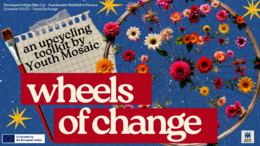
Wheels of Change – Upcycling Toolkit
A hands-on upcycling workshop: small mixed groups turn discarded bicycle wheels into collective artworks made of reused materials, then name and present the message behind them. Tested in the Erasmus+ youth exchange Bike-Up! in Ferrara.
Aims of the tool
The tool helps young people experience reuse and the circular economy as a practical process rather than as a topic to be explained. An object that had already been thrown away, an old bicycle wheel, is given a second life, and the meaning of that second life is decided entirely by the group that works on it.
In small mixed groups, participants agree on a theme, choose among reused materials and transform the wheel into a collective artwork, which they then name, explain in a short presentation and display in a public or community space. Making the result visible is what closes the learning loop: reuse stops being a good intention and becomes something the group has produced, can show and can argue for.
Alongside this, the activity builds cooperation and negotiation in mixed international groups, creative expression that requires no artistic or technical skill, and an explicit link between the bicycle as a symbol of green mobility and the everyday choices participants make about what they throw away.
OBJECTIVES
By the end of the 90 to 120 minute workshop, each small group transforms at least one discarded wheel into a finished collective artwork made predominantly of reused materials, and presents its meaning in a two to three minute group presentation.
During the workshop, every participant makes at least one visible contribution to the group's creative decisions: an idea, a material choice, a manual task, a message or a role in the presentation.
By the final reflection, each participant can name at least two circular economy or reuse principles and connect them to one personal everyday action.
Description of the tool
Wheels of Change is a hands-on upcycling workshop in which small mixed groups transform old, discarded bicycle wheels into collective artworks, using fabric scraps, ribbons, beads, paper and other reused materials. It was developed and tested during Bike-Up! – Sustainable Mobility in Ferrara, an Erasmus+ KA152 youth exchange, and it is documented here so that any youth organisation can run it with its own group and its own materials. The value of the activity is in the process: participants discuss, experiment, negotiate and create together, and the finished wheel is the visible trace of that shared work.
WHY THE WHEEL
The bicycle wheel is not a neutral support. It carries a set of meanings that mirror what the activity wants participants to learn and to feel, and facilitators are encouraged to use them during the reflection:
the cycle: a wheel exists to move things forward, a natural image of change and green transition;
spokes and rim: many spokes under tension, held together by one rim, an image of cohesion and shared responsibility, where a loss of balance or tension weakens the whole wheel, as it does in a group;
the hub: the shared centre, the common values the group builds around;
balance: a wheel only rolls when it is balanced, a metaphor for sustainability;
a discarded wheel given new life: what was thrown away becomes meaningful again.
The closing question of the activity follows from this: if a broken wheel can become art, what else that we discard could be re-valued?
BEFORE THE ACTIVITY
The facilitators collect and clean the wheels, one per group, and remove sharp spokes and burrs so that they can be handled safely. Wheels can be sourced from bike shops, repair points and local cycling groups, which normally discard them. The reused materials and the tools are sorted into open boxes within reach of every table, so that nobody has to ask in order to use them, and the work area is checked. Photo consent is agreed with the participants before the session, since the activity produces a large amount of visual documentation.
RUNNING THE SESSION
OPEN IT: a short introduction to the link between bicycles, sustainability, reuse and creative upcycling. Keep it simple, because the meaning of each wheel comes from the participants and not from the introduction.
FORM THE GROUPS: mixed groups of four to six people, one wheel per group and free access to the recycled materials.
AGREE AN IDEA: each group agrees on a common idea, mood or message, which can be symbolic, colourful, abstract, poetic or playful. Themes can include reuse, movement, community, cooperation, inclusion, climate action, circular economy and future cities. The meaning belongs entirely to the group.
MAKE IT: participants wrap ribbons and fabrics around the rim, weave textile scraps through the spokes, attach flowers, beads, buttons and paper, add short written messages and build patterns and textures into one collective composition.
THE ROLE OF THE FACILITATOR
The facilitator stays outside the creative process: watching it, keeping it safe, managing the time and holding a respectful and inclusive space. The creative decisions belong to the participants, and the facilitator stays neutral on meaning and style. While the groups work, the facilitator asks the questions of the learning cycle, so that meaning grows alongside the artwork instead of being added at the end.
THE PRESENTATION AND THE CLOSING
Each group presents its wheel in two to three minutes. The presentation is short, informal and about meaning rather than technique, and it is guided by six questions: what is the name of your wheel? how did you create it? which recycled materials did you use, and why? what message does it communicate? where could it be displayed? what did you learn while creating it together? The closing connects the experience back to sustainability, reuse and cooperation, and each participant names one concrete thing they will reuse or do differently.
THE LEARNING CYCLE
The activity follows the four stages of the experiential learning cycle, and each stage has its own questions.
1. Concrete experience: handling the prepared wheel and exploring the reused materials. Ask: what does this discarded wheel make you think of? How does it feel to work with something someone threw away?
2. Reflective observation: choosing materials and starting to wrap, weave and attach. Ask: which materials did you choose, and why? What are you noticing about how your group decides together?
3. Conceptualisation: assembling the collective composition, naming the wheel and its message. Ask: what does your wheel represent? How do the spokes and the rim mirror your group or your community?
4. Application: presenting the wheel, deciding where to display it, naming a personal action. Ask: what message will this wheel carry to others? What is one thing you will reuse or change after today?
LEARNING OUTCOMES
By the end of the activity, participants have:
1. experienced upcycling as a practical and creative process;
2. reflected on reuse, waste reduction and the circular economy;
3. connected the bicycle with sustainable mobility and greener communities;
4. worked together to create a shared artistic result;
5. used art as a tool for environmental awareness and active citizenship;
6. contributed to a collective creation shared with the wider community.
RECOGNITION OF LEARNING
The final reflection names the key competences explicitly, together with the evidence the activity itself produces, so that participants can recognise their learning when writing their Youthpass:
cultural awareness and expression: expressing ideas and values through colour, texture and symbol, with the finished wheel as evidence;
personal, social and learning to learn competence: negotiating ideas, sharing roles and tools, reflecting on one's own way of working, with balanced participation as evidence;
citizenship competence: acting on environmental responsibility and carrying the message outside the group, with the displayed wheel as evidence.
SAFETY AND ACCESSIBILITY
Hot glue guns require facilitator supervision and a dedicated, stable station, and adult supervision is required whenever minors take part. Sharp spokes and burrs are removed from the wheels before the session. Glue-free fixing options, such as tape, wire ties and knots, are always available, together with tasks that require no tools at all, so that nobody has to handle heat or blades in order to take part fully.
DISSEMINATION AND FOLLOW-UP
The activity produces strong visual material: photos of the working process and of the finished wheels, short video clips of the creative phase, the group presentations, captions explaining the materials used and participants' short reflections. The wheels themselves are the follow-up. They are displayed in youth centres, schools, project venues, community festivals, public events, bike-related initiatives and local exhibitions, so that the message keeps travelling after the workshop has ended.
WHAT THE TOOLKIT CONTAINS
The toolkit describes the project the tool comes from, the metaphor of the wheel, the objectives and the learning outcomes, the key competences with their evidence, the full list of materials and tools, the timing and the safety rules, the step-by-step run of the session with the facilitator's role and the presentation questions, the learning cycle with its questions, the facilitation tips and the guidance on documentation and display. The Educational Pathway of Bike-Up! is attached as a second document and describes the wider non-formal education framework the tool was developed in.
MAKING IT YOURS
The structure works in any context: keep the process, which is to agree an idea, build it together, present it and display it, and change the theme, the materials and the display place to fit your own group and town. The tool was designed for an international youth exchange, but it works equally well with a local youth group, a school class or a community event.
Available downloads:
Disclaimer
SALTO cannot be held responsible for the inappropriate use of these training tools. Always adapt training tools to your aims, context, target group and to your own skills! These tools have been used in a variety of formats and situations. Please notify SALTO should you know about the origin of or copyright on this tool.
Tool overview
http://toolbox.salto-youth.net/6005
This tool is for
The tool is designed for young people aged 18 to 26, the age group it was tested with. It works best here because the creative work happens in small peer teams that agree on an idea and carry it out on their own, without an adult leading them. It is also addressed to youth workers, educators, trainers and community facilitators looking for a practical, low-cost activity on reuse and sustainability. The activity runs in mixed groups of four to six people, one wheel per group. It was tested with 27 participants from five countries. No previous artistic or technical skill is needed, either from the participants or from the facilitator. It can also be run with younger groups, from 13, and with mixed-age groups up to 30, if the facilitator slows the pace and gives more guidance. Adult supervision is required when minors take part, and the glue-free options keep the activity open to anyone who prefers not to use heat or blades.
and addresses
Intercultural Learning, Personal Development, Youth Participation, Environment
It is recommended for use in:
Youth Exchanges
Training and Networking
Materials needed:
Main materials:
- discarded bicycle wheels, one per group;
- fabric scraps, ribbons, strings, wool;
- beads, buttons, artificial flowers, old decorations;
- reused paper and cardboard, textile leftovers, small recycled objects;
- paper strips for short written messages.
Tools:
- scissors;
- hot glue guns and glue sticks;
- tape;
- markers and pens;
- pliers if needed;
- tables or stable surfaces, one per group.
Optional:
- old maps, bottle caps, coloured paper, reused packaging, small bells, natural elements.
Safety and documentation:
- a dedicated, supervised station for the hot glue guns;
- glue-free fixing options (tape, wire ties, knots);
- a basic first-aid kit;
- photo and video consent forms if the activity will be documented;
- a place to display the finished wheels.
Duration:
90 to 120 minutes in total:
10 min introduction to the topic
5-10 min materials and safety briefing
10-15 min group idea development
45-60 min creative work
15-20 min presentation of the artworks
10 min final reflection
The preparation done by the facilitators before the session (collecting and cleaning the wheels, removing sharp parts, sorting the materials into open boxes) is not included in this timing and needs to be planned in advance.
Behind the tool
The tool was created by
Youth Mosaic, Bondeno (Ferrara), Italy – youthmosaic.ita@gmail.com
in the context of
Bike-Up! – Sustainable Mobility in Ferrara, Erasmus+ KA152-YOU Youth Exchange (project no. 2025-3-IT03-KA152-YOU-000387510), coordinated by Youth Mosaic in Ferrara, Italy, 1-7 May 2026, with partners from Romania, Jordan, Türkiye and Ireland.
The tool has been experimented in
Erasmus+ KA152-YOU Youth Exchange (Bike-Up! – Sustainable Mobility in Ferrara, Italy, 1-7 May 2026), with 25 participants from Italy, Romania, Jordan, Türkiye and Ireland.
The tool was published to the Toolbox by
Sonia Djadi (on 21 September 2026)
and last modified
18 September 2026
Comments
No comments have been posted yet.
If you want to comment on this tool, you need to be signed in with your MySALTO account. Sign in now