Toolbox — For Training and Youth Work
All new tools in your inbox: Be the first to know about new tools for learning with our e-mail notifications.
Manual
Turn off the light - learning programme
Light-pollution education programme for ages 15–19: astronomy, ecology, mental health, IoT monitoring and data analysis. Includes ready-to-run lesson plans, activities, worksheets, reflection questions and Kahoot quizzes promoting dark-sky awareness.
Aims of the tool
The programme aims to raise awareness of light pollution and its impacts on astronomy, ecosystems and human health, while equipping young people with practical skills to measure, analyse and reduce light pollution through observation, data analysis, responsible lighting practices and technology-based solutions.
Description of the tool
Turn Off the Light is an interdisciplinary educational programme designed for young people aged 15–19 that explores one of the fastest-growing environmental challenges of the modern world: light pollution. Through a combination of science, environmental education, technology, data analysis, and civic engagement, learners discover how excessive artificial light affects the night sky, biodiversity, human health, and energy consumption.
The programme combines theoretical knowledge with hands-on activities, encouraging learners to investigate real-world problems, collect and analyse data, build technological solutions, and develop practical strategies for protecting natural darkness.
The learning activities are aligned with European educational frameworks and support the development of scientific literacy, digital competence, critical thinking, problem-solving, collaboration, and environmental responsibility.
1. Light Pollution and Astronomy
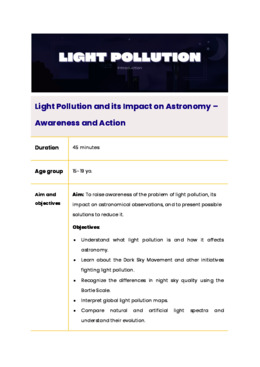
Learners investigate what light pollution is, how it alters our view of the night sky, and why it poses a challenge for astronomy. Through interactive discussions, night-sky observations, map analysis, and the use of the Bortle Scale, participants learn to assess sky quality and understand global patterns of artificial night-time brightness.
Topics include:
* Types and causes of light pollution
* Effects on astronomical observations
* The Dark Sky Movement and Dark Sky Parks
* The Bortle Scale and night-sky quality assessment
* Interpretation of global light pollution maps
* Practical solutions for reducing light pollution
Learning Outcomes
Learners will be able to:
* Explain what light pollution is and how it affects astronomical observations.
* Understand the difference between natural and artificial sources of light.
* Use the Bortle Scale to evaluate night-sky quality.
* Interpret light-pollution maps and identify regional patterns.
* Describe international initiatives working to protect dark skies.
* Propose practical actions to reduce unnecessary artificial lighting.
2. Light Pollution and Ecosystems
The programme introduces the concept of Artificial Light at Night (ALAN) and examines its effects on wildlife, plants, and ecosystem functioning. Through simulations, observations, and group discussions, learners explore how species depend on natural light-dark cycles and how artificial illumination disrupts ecological balance.
Topics include:
* Natural versus artificial night environments
* Nocturnal and crepuscular species
* Pollination, migration, feeding, and reproduction
* Habitat fragmentation caused by lighting
* Responsible lighting practices for biodiversity protection
Learning Outcomes
Learners will be able to:
* Define Artificial Light at Night (ALAN).
* Describe how light pollution affects animals, plants, and ecosystems.
* Explain the ecological roles of nocturnal species.
* Identify behavioural changes caused by excessive artificial lighting.
* Evaluate the environmental consequences of long-term light exposure.
* Recommend biodiversity-friendly lighting solutions for communities.
3. Light Pollution and Human Health
Learners explore the relationship between light exposure, circadian rhythms, sleep, and mental wellbeing. The module introduces the biological mechanisms through which light influences the human body and discusses current research linking artificial light at night with health outcomes.
Topics include:
* Circadian rhythms and the body clock
* Melatonin production and sleep regulation
* Blue light and its effects
* Mental health implications of disrupted sleep
* Personal and community-level mitigation strategies
Learning Outcomes
Learners will be able to:
* Explain how light influences human physiology and behaviour.
* Describe the role of melatonin and circadian rhythms.
* Understand the relationship between artificial light exposure and sleep quality.
* Discuss links between circadian disruption and mental health.
* Identify behaviours that reduce harmful light exposure.
* Advocate for responsible lighting practices that support wellbeing.
4. Technology and IoT for Environmental Monitoring
The programme introduces learners to embedded systems, sensors, microcontrollers, and the Internet of Things (IoT). Participants build a cloud-connected light monitoring system using an ESP8266 microcontroller and a light sensor, collecting real environmental data and visualising it online.
Topics include:
* Embedded systems and microcontrollers
* Sensor technology and light measurement
* Wireless communication and cloud platforms
* Internet of Things concepts
* Data visualisation and environmental monitoring
Learning Outcomes
Learners will be able to:
* Program a microcontroller to collect sensor data.
* Connect environmental sensors to cloud platforms.
* Understand how IoT systems communicate and exchange information.
* Visualise environmental data using online dashboards.
* Apply programming and engineering skills to real-world challenges.
* Design technology-based solutions to environmental problems.
5. Scientific Data Collection and Analysis
Learners experience the complete scientific process by planning observations, collecting night-sky brightness measurements, cleaning datasets, performing statistical analyses, and interpreting results. They investigate environmental factors affecting sky brightness and explore possible relationships between solar activity and observational data.
Topics include:
* Scientific observation methods
* Data collection and quality control
* Statistical analysis and visualisation
* Twilight phases and sky brightness
* Correlation and trend analysis
* Scientific interpretation and reporting
Learning Outcomes
Learners will be able to:
* Conduct systematic environmental observations.
* Organise, clean, and analyse datasets.
* Create graphs and visual representations of scientific data.
* Identify patterns caused by natural and artificial influences.
* Understand basic statistical concepts and correlations.
* Draw evidence-based conclusions and communicate findings.
Teaching and Learning Approach
The programme uses a variety of learner-centred methodologies:
* Interactive discussions and brainstorming
* Inquiry-based learning
* Problem-solving activities
* Role-play and simulations
* Field observations
* Data analysis and visualisation
* Practical technology projects
* Reflection and self-assessment
Each module includes structured lesson plans, worksheets, observation tasks, reflection questions, and Kahoot quizzes that support both classroom and non-formal learning environments.
Available downloads:
Disclaimer
SALTO cannot be held responsible for the inappropriate use of these training tools. Always adapt training tools to your aims, context, target group and to your own skills! These tools have been used in a variety of formats and situations. Please notify SALTO should you know about the origin of or copyright on this tool.
Tool overview
http://toolbox.salto-youth.net/5825
This tool is for
Young people aged 15–19 years, including secondary school students, youth groups, STEM clubs, and participants in environmental education programmes. Suitable for use by teachers, educators, and youth workers in both formal and non-formal learning settings.
and addresses
Environment
Materials needed:
Depending on the activity, materials may include:
* Computer or laptop with internet access
* Projector and presentation materials
* Worksheets and observation sheets
* Smartphones or tablets
* Night-sky observation tools (optional)
* ESP8266 (NodeMCU) microcontroller
* Light sensor (e.g., BH1750)
* Jumper wires and USB cable
* Arduino IDE or TUNIOT software
* Access to cloud platforms (e.g., ThingSpeak)
* Spreadsheet software (Excel, Google Sheets, LibreOffice Calc)
Most activities can be completed with standard classroom equipment, while the technology modules require basic electronics and IoT components.
Duration:
The programme consists of five learning modules, each lasting approximately 45–90 minutes. Depending on the selected activities and practical exercises, the complete programme can be delivered in 6–10 hours of learning time.
The programme can be delivered as a series of standalone workshops or as a complete learning pathway.
Behind the tool
The tool was created by
Team of Turn off the lights project
in the context of
KA2
The tool has been experimented in
pilot workshops
The tool was published to the Toolbox by
Agnieszka Mirocha (on 8 July 2026)
and last modified
26 June 2026
Comments
No comments have been posted yet.
If you want to comment on this tool, you need to be signed in with your MySALTO account. Sign in now