Toolbox — For Training and Youth Work
All new tools in your inbox: Be the first to know about new tools for learning with our e-mail notifications.
Background Text, Manual
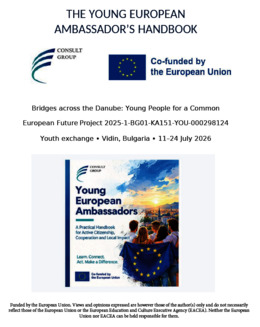
The Young European Ambassador’s Handbook
A practical handbook created by Bulgarian and Romanian young people, offering guidance, good practices and tools for European citizenship, international cooperation, intercultural dialogue and youth-led initiatives.
Aims of the tool
The handbook aims to:
- Strengthen young people's understanding of European citizenship, EU values and international cooperation.
- Promote intercultural dialogue, tolerance, solidarity and active democratic participation.
- Develop young people's ability to identify community needs, generate ideas and plan youth-led initiatives.
- Provide youth workers and organisations with accessible information, examples and practical tools for non-formal education.
- Encourage cross-border cooperation between young people, particularly from Bulgaria and Romania.
- Support inclusion, equal participation and environmentally responsible behaviour in youth activities.
Description of the tool
The Young European Ambassador’s Handbook is a practical educational resource developed with the active participation of young people from Bulgaria and Romania during the Erasmus+ youth exchange “Bridges Across the Danube: Young People for a Common European Future”.
The handbook brings together knowledge, experiences, examples and ideas explored during the exchange. It focuses on international cooperation, European citizenship, intercultural dialogue, democratic participation and the role of young people in their communities.
The resource includes:
An introduction to the project and its educational objectives.
Key concepts related to international cooperation and European citizenship.
Good practices and examples from Bulgaria and Romania.
Ideas for youth-led civic and volunteering initiatives.
Practical tools for working with young people.
Examples of cooperation between young people from different countries.
Recommendations for future youth initiatives.
Messages from participants to other young people.
Practical guidance for organising a small youth initiative.
The handbook also presents two proposals developed by mixed Bulgarian–Romanian youth teams: the “Danube Youth Opportunity Map”, a proposed digital resource highlighting youth opportunities, and “Two Countries, One Act of Solidarity”, a concept for coordinated volunteering actions in Bulgaria and Romania.
These are proposals for possible future implementation, not activities already carried out.
The handbook can be used for individual learning, group discussions, youth workshops, volunteering preparation and international youth projects.
Expected learning outcomes include improved understanding of EU values, stronger intercultural communication, critical thinking, teamwork, civic awareness and the ability to develop ideas for community initiatives.
The electronic format makes the resource easy to share, adapt to different learning contexts and use beyond the original project.
Available downloads:
Disclaimer
SALTO cannot be held responsible for the inappropriate use of these training tools. Always adapt training tools to your aims, context, target group and to your own skills! These tools have been used in a variety of formats and situations. Please notify SALTO should you know about the origin of or copyright on this tool.
Tool overview
http://toolbox.salto-youth.net/6123
This tool is for
Young people aged 18–30, including young people with fewer opportunities; youth workers, youth leaders, trainers, facilitators, volunteers and youth organisations. The handbook is particularly relevant for individuals and organisations interested in European citizenship, international cooperation, intercultural learning, democratic participation, volunteering and youth-led community initiatives. It can also be adapted for use with younger participants in educational settings, with appropriate facilitation.
and addresses
Youth Initiatives, Networking and Follow-up, Intercultural Learning, European Citizenship, Youth Participation
It is recommended for use in:
Youth Exchanges
Training and Networking
Materials needed:
A digital copy of the handbook (PDF) and a smartphone, tablet or computer for reading.
For group activities: internet access (optional), a projector or screen, paper, pens and other basic materials for discussions, teamwork and planning exercises.
Printed copies may also be used.
Duration:
Flexible duration, depending on the learning objectives and target group.
Individual reading and reflection: approximately 30–60 minutes.
Facilitated group workshop: approximately 60–120 minutes, depending on the selected topics and activities.
Suggested learning process:
Introduce the handbook and the learning objectives.
Select a topic relevant to the participants.
Explore the key concepts and practical examples.
Facilitate a group discussion or teamwork activity.
Invite participants to develop a small youth initiative or cooperation idea.
Conclude with reflection on learning outcomes and possible next steps.
The handbook is designed for flexible use and does not require a fixed training programme.
Behind the tool
The tool was created by
Consult Group and ASOCIATIA TINERII 3 D, with the active participation of young people from Bulgaria and Romania.
in the context of
Developed during the Erasmus+ KA151-YOU youth exchange “Bridges Across the Danube: Young People for a Common European Future”, project No. 2025-1-BG01-KA151-YOU-000298124, held in Vidin, Bulgaria, from 11 to 24 July 2026. The project was implemented by C
The tool has been experimented in
Erasmus+ Youth Exchange (KA151-YOU), Vidin, Bulgaria, 11–24 July 2026. The handbook was co-created through non-formal learning workshops, international teamwork, discussions and practical activities.
The tool was published to the Toolbox by
Filip Nedyalkov (on 2 November 2026)
and last modified
27 October 2026
Comments
No comments have been posted yet.
If you want to comment on this tool, you need to be signed in with your MySALTO account. Sign in now