Toolbox — For Training and Youth Work
All new tools in your inbox: Be the first to know about new tools for learning with our e-mail notifications.
Simulation Exercise, Exercise, Presentation, Info session
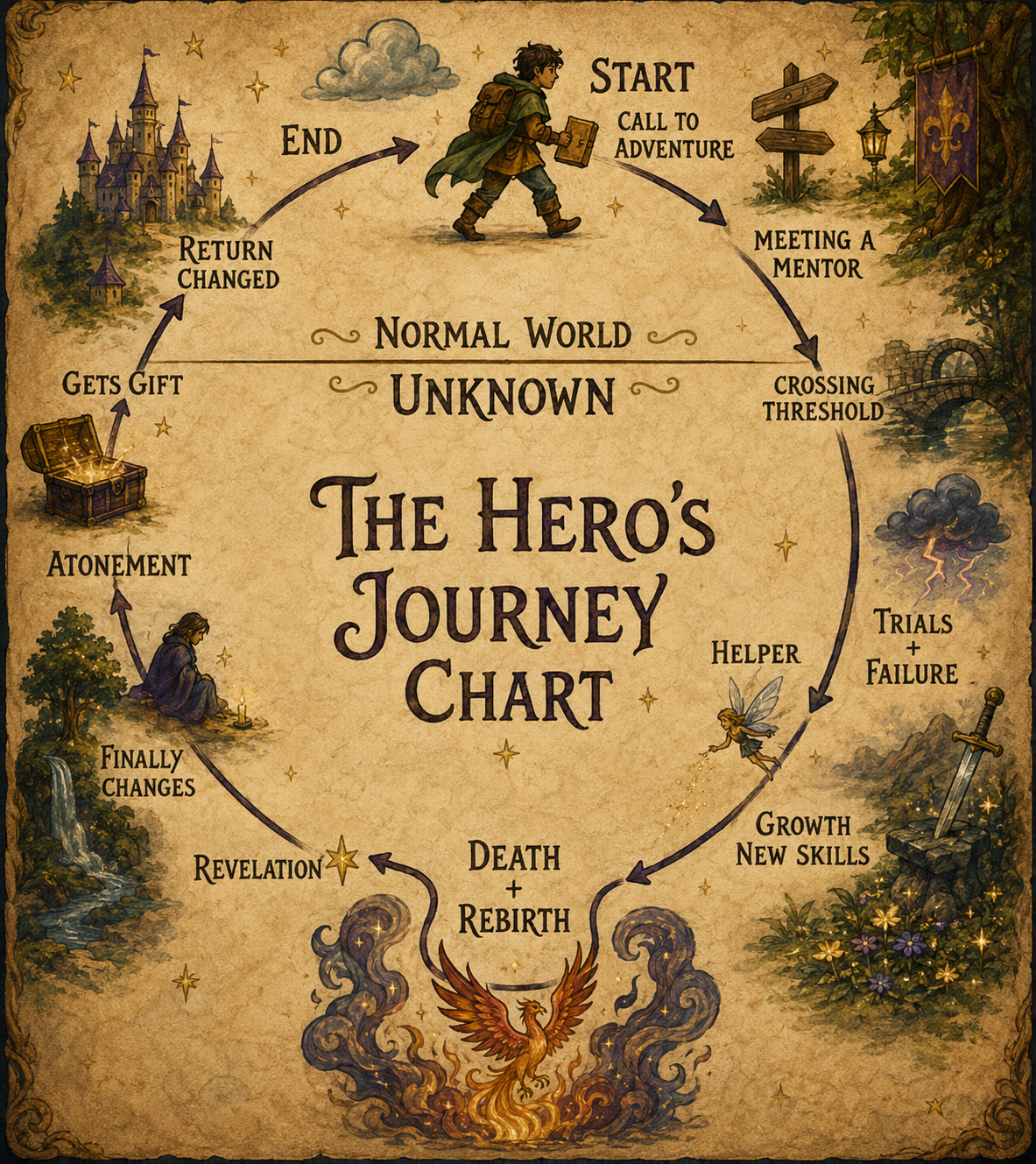
The Journey of Transformation: Story Arc & Hero's Journey Framework
A storytelling and theatre tool combining the Hero’s Journey and Story Arc to help participants create engaging stories, role-plays, and intercultural learning experiences with a clear structure, emotional tension, transformation, and meaning.
Aims of the tool
- To provide a clear and practical framework for creating engaging, meaningful, and well-structured stories;
- To help participants understand and apply the principles of the Hero’s Journey (Monomyth) and the Arc of the Story;
- To develop storytelling, role-play, theatre, and narrative design skills;
- To support the creation of emotionally engaging stories with a coherent progression of tension and transformation;
- To strengthen creativity, imagination, and narrative thinking;
- To explore personal, social, and intercultural themes through storytelling;
- To improve communication, empathy, and perspective-taking by working with characters and their journeys;
- To provide a structure for designing educational, theatrical, role-play, and simulation-based activities;
- To help participants identify key story elements: setting, characters, conflict, climax, transformation, and resolution;
- To enhance intercultural learning by using universal narrative patterns that can be adapted to different cultural contexts.
Description of the tool
The Story Arc & Hero’s Journey Framework is a storytelling, role-play, theatre, and simulation tool based on two complementary narrative models: Joseph Campbell’s Hero’s Journey (Monomyth, J. Campbell, 1949) and the Arc of the Story.
The tool helps participants create clear, engaging, and emotionally meaningful stories by following a structured narrative journey: from establishing the setting and characters, through conflict and climax, to transformation and resolution. It visualizes how emotional tension develops throughout a story and demonstrates how challenges, choices, and personal growth drive both narratives and learning processes.
The framework can be used in storytelling, creative writing, theatre, improvisation, simulations, role-play activities, intercultural learning, youth work, and personal development. It provides a universal structure that can be adapted to different cultures, topics, and educational contexts while encouraging creativity, empathy, reflection, and active participation.
Learning Outcomes
Participants will:
- Understand the key stages of the Hero’s Journey and the Story Arc;
- Learn how to structure coherent and emotionally engaging stories;
- Understand the role of conflict, climax, and transformation in storytelling;
- Develop storytelling, creative thinking, improvisation, and communication skills;
- Explore personal, social, and intercultural themes through narrative and role-play;
- Use storytelling as a tool for learning, reflection, and meaningful dialogue.
Facilitator's Tip:
This framework is primarily a visualization tool that helps participants understand and apply the key stages of story creation and narrative development. It can be used as a simple guide for designing stories, role-plays, simulations, theatre performances, and educational activities.
For a deeper exploration of the Hero’s Journey (Monomyth), facilitators are encouraged to refer to Joseph Campbell's book The Hero with a Thousand Faces (1949) and related resources on Campbell’s work and comparative mythology.
Available downloads:
.PNG)
Disclaimer
SALTO cannot be held responsible for the inappropriate use of these training tools. Always adapt training tools to your aims, context, target group and to your own skills! These tools have been used in a variety of formats and situations. Please notify SALTO should you know about the origin of or copyright on this tool.
Tool overview
http://toolbox.salto-youth.net/5758
This tool addresses
Intercultural Learning, Personal Development, Youth Participation
It is recommended for use in:
Youth Exchanges
Training and Networking
Behind the tool
The tool was created by
Vladimir Kozachun
in the context of
Erasmus+ Training Course "NICE AI: Navigating Intercultural Communication and Exploration with AI tools" 10-21 May 2026 in Armenia, Abovyan
The tool was published to the Toolbox by
Vladimir Kozachun (on 5 June 2026)
and last modified
4 June 2026
Comments
No comments have been posted yet.
If you want to comment on this tool, you need to be signed in with your MySALTO account. Sign in now