Toolbox — For Training and Youth Work
All new tools in your inbox: Be the first to know about new tools for learning with our e-mail notifications.
Manual
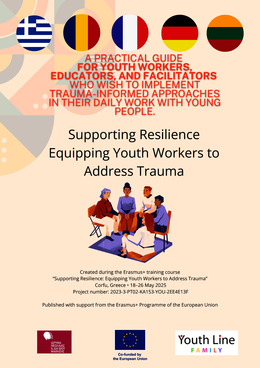
Supporting Resilience Equipping Youth Workers to Address Trauma
To equip youth workers with trauma-informed tools and practices, enhance their capacity to support young people facing adversity, and promote safe, inclusive, and resilient youth work environments across Europe.
Aims of the tool
The aim of this tool is to provide youth workers, educators, and trainers with accessible, trauma-informed methods and approaches that can be applied in their daily youth work practice. It seeks to enhance their capacity to recognise and respond to the emotional and psychological needs of young people, especially those who have experienced adversity or trauma. The guide also aims to promote resilience, empathy, and emotional safety within youth work settings, contributing to more inclusive and supportive environments where all young people can thrive.
Description of the tool
"Supporting Resilience: Equipping Youth Workers to Address Trauma" is a practical guide developed during an Erasmus+ training course that brought together youth workers from five countries. The guide offers concrete tools, reflection methods, and trauma-informed approaches that can be directly applied in youth work settings.
It is designed to help youth workers better understand trauma, recognise common emotional responses, and create safe, inclusive environments for young people. The content includes body-based methods, non-formal education tools, active listening techniques, and peer-to-peer activities. It also introduces methods like the “Resilience Tree”, case study analysis, and grounding exercises.
Learning outcomes include:
Increased awareness of trauma and its effects on young people;
Ability to apply the 6 principles of trauma-informed care in youth work;
Improved active listening and nonviolent communication skills;
Greater capacity to support young people without judgement or “fixing”;
Knowledge of practical tools to build resilience and emotional safety;
Skills to create inclusive group agreements and reflective spaces.
The guide supports the professional development of youth workers and contributes to the broader goals of the European Youth Work Agenda by promoting well-being, inclusion, and competence-based learning.
Available downloads:
Disclaimer
SALTO cannot be held responsible for the inappropriate use of these training tools. Always adapt training tools to your aims, context, target group and to your own skills! These tools have been used in a variety of formats and situations. Please notify SALTO should you know about the origin of or copyright on this tool.
Tool overview
http://toolbox.salto-youth.net/5182
This tool is for
Youth workers, educators, trainers, social workers, youth leaders, and organisations working with young people, especially those supporting individuals affected by trauma, stress, or social exclusion.
and addresses
Social Inclusion, Personal Development, Peer education
It is recommended for use in:
Training and Networking
Materials needed:
Paper, pens, markers, flipcharts, printed emotion cards or images (e.g. Dixit), post-its, natural objects (stones, leaves), basic art supplies (scissors, glue, magazines), and a quiet, safe space for group work and reflection.
Behind the tool
The tool was created by
Youth Line Greece
in the context of
This tool was created in the context of the Erasmus+ training course “Supporting Resilience: Equipping Youth Workers to Address Trauma,” held from 18–26 May 2025 in Corfu, Greece
The tool was published to the Toolbox by
Kateryna Shepeliuk (on 3 November 2025)
and last modified
30 October 2025
Comments
No comments have been posted yet.
If you want to comment on this tool, you need to be signed in with your MySALTO account. Sign in now