Toolbox — For Training and Youth Work
All new tools in your inbox: Be the first to know about new tools for learning with our e-mail notifications.
Exercise, Background Text, Manual
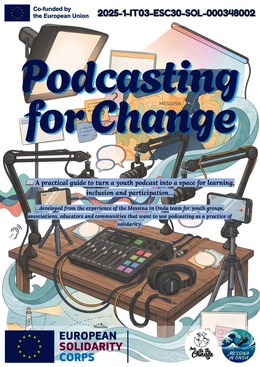
Podcasting for Change: A Practical Guide to Youth-Led Community Podcasting
An accessible, practice-based toolkit that helps youth groups turn podcasting into non-formal learning, inclusion and community participation, from team building and safe interviewing to production, outreach, Youthpass and continuity.
Aims of the tool
The toolkit aims to help young people and youth workers:
- transform podcasting into a youth-led non-formal learning process;
- strengthen communication, teamwork, interviewing, media and digital storytelling competences;
- create safer and more inclusive participation, including for young people with fewer opportunities;
- produce accessible bilingual audio and video content;
- connect personal stories with local communities and youth organisations;
- reflect on learning through Youthpass and plan continuity beyond a single episode.
Description of the tool
Podcasting for Change is a practice-based guide developed from Messina in Onda, a youth-led European Solidarity Corps solidarity project implemented in Messina, Italy with the support of Be The Change. It shows how to turn a podcast from a media product into a repeatable non-formal learning process and a space for participation.
The guide is organised in twelve steps: orientation, team roles, learning by doing, experimentation, episode planning, guest care, technical setup, editing, bilingual accessibility, community activation, impact and Youthpass, and continuity. It combines concise theory with tested workflows, equipment diagrams, real implementation photographs, facilitation tips, inclusion measures, reflection prompts and seven printable worksheets.
Users can follow the complete 30-day pathway, deliver an eight-module training programme or select individual sections for a workshop. The method works with accessible equipment—from smartphones and a basic recorder to a three-microphone and two-camera setup—and stresses consent, safeguarding, continuous accessibility, shared responsibilities and support for participants with fewer opportunities.
Learning outcomes include the ability to:
- plan and coordinate a youth-led podcast;
- prepare and conduct safe, respectful interviews;
- record, edit and publish accessible bilingual content;
- develop teamwork, communication, digital and organisational competences;
- connect episodes with community events and participation;
- document learning and recognise it through Youthpass;
- create a realistic continuity plan.
The toolkit is available in English and Italian and can be adapted by youth groups, youth workers, NGOs, educators and community organisations.
Available downloads:
Disclaimer
SALTO cannot be held responsible for the inappropriate use of these training tools. Always adapt training tools to your aims, context, target group and to your own skills! These tools have been used in a variety of formats and situations. Please notify SALTO should you know about the origin of or copyright on this tool.
Tool overview
http://toolbox.salto-youth.net/5894
This tool is for
Young people aged approximately 16–30, youth workers, youth leaders, trainers, facilitators, educators, European Solidarity Corps volunteers, informal youth groups and youth organisations. It is particularly useful for groups that want to strengthen youth participation, digital storytelling and community dialogue, including participants with fewer opportunities or different language levels. No advanced technical experience is required. The activities work best with a core group of 4–12 people and can also involve guests, audiences and wider community members.
and addresses
Social Inclusion, Youth Initiatives, Project Management, Personal Development, Youth Participation
It is recommended for use in:
Training and Networking
Transnational Youth Initiatives
Materials needed:
Minimum: the toolkit in digital or printed form, pens or sticky notes, a smartphone or basic audio recorder, headphones and a quiet space.
Recommended for group production: one to three dynamic microphones, XLR cables, an audio interface or multitrack recorder, and a laptop with editing software. For video, add one or two smartphones or cameras, tripods and basic lighting. The method can be scaled down and expensive equipment is not required.
Duration:
The toolkit is flexible and can be used as:
- a 90–120 minute introductory workshop;
- an eight-module learning programme;
- a two- or three-day intensive laboratory; or
- a 30-day pathway from the initial idea to publication and follow-up.
A complete pilot episode usually requires 8–12 hours distributed across orientation, team roles, topic and guest preparation, practice, recording, editing, accessibility, publication, reflection and continuity. Each phase combines short exercises, practical tasks, debriefing and transfer to the group’s local context.
Behind the tool
The tool was created by
The Messina in Onda core team: Mohamed Naim, Carim Gemelli, Amin Tahirli, Yana Sopp, Arlan Alin and Lamia Rahali with the support of coach Emanuel Caristi and Be The Change.
in the context of
Developed within the European Solidarity Corps Solidarity Project “Messina in Onda”, project number 2025-1-IT03-ESC30-SOL-000348002, implemented in Messina, Italy, with the support of Be The Change.
The tool has been experimented in
The method was tested through in-person and online team training, pilot recordings, bilingual interviews, hands-on podcast sessions involving more than 100 young people, community outreach, international non-formal education activities and a final public
The tool was published to the Toolbox by
Emanuel Caristi
and last modified
25 July 2026
Comments
No comments have been posted yet.
If you want to comment on this tool, you need to be signed in with your MySALTO account. Sign in now