Toolbox — For Training and Youth Work
All new tools in your inbox: Be the first to know about new tools for learning with our e-mail notifications.
Exercise, Manual, Report
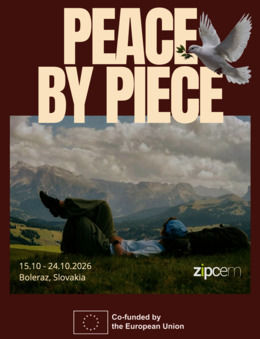
PEACE BY PIECE
Peace by Piece is a practical toolkit for youth workers exploring peacebuilding, conflict resolution, nonviolent communication and human rights through background information, role plays, intercultural simulations and reflection.
Aims of the tool
The toolkit aims to strengthen youth workers’ capacity to address conflict constructively and promote peaceful, inclusive communities. It supports understanding of conflict dynamics, develops empathy and nonviolent communication skills, and encourages critical reflection on stereotypes, discrimination and hate speech. It also provides practical activities that educators can adapt to help young people explore human rights, equality and intercultural dialogue.
Description of the tool
eace by Piece is an educational resource developed through an international Erasmus+ training course. It combines introductory concepts, examples, practical activities and participants’ reflections to support learning about peacebuilding in youth work.
The toolkit explores different types of conflict, the five conflict management styles of the Thomas-Kilmann model, and the four components of Nonviolent Communication: observation, feelings, needs and requests. It also addresses stereotypes, xenophobia, hate speech and human rights, alongside historical examples of collective action and nonviolent resistance.
Its practical section presents five activities: Chahal vs UK, Bafa-Bafa, Path to Equality-land, The Stereo Walk and Derdians. These use role play, intercultural simulation, creative group work and perspective taking to explore human dignity, cultural differences, gender equality and discrimination. Reflection and debriefing help participants connect their experiences to everyday life and youth work.
Depending on the activities selected, learners will be able to:
- Recognise different types of conflict and compare possible responses.
- Distinguish observations from judgements and express feelings, needs and requests more clearly.
- Practise empathetic listening and consider perspectives different from their own.
- Identify stereotypes, prejudice and mechanisms of exclusion.
- Recognise how hate speech and discriminatory narratives affect individuals and communities.
- Discuss human rights and equality through concrete situations.
- Reflect on their own assumptions and identify practical ways to support inclusion.
- Transfer selected methods and insights into their youth work or educational practice.
The toolkit can support facilitated workshops, training courses, youth exchanges and individual preparation by educators.
Available downloads:
Disclaimer
SALTO cannot be held responsible for the inappropriate use of these training tools. Always adapt training tools to your aims, context, target group and to your own skills! These tools have been used in a variety of formats and situations. Please notify SALTO should you know about the origin of or copyright on this tool.
Tool overview
http://toolbox.salto-youth.net/6110
This tool is for
Youth workers, youth leaders, trainers, teachers, facilitators and youth organisations working on peacebuilding, human rights, inclusion and intercultural learning. Selected activities can also be adapted for young people and students. Facilitators should choose activities according to participants’ age, experience and support needs. The Stereo Walk specifically identifies young people aged 10–18 as a target group.
and addresses
Group Dynamics, Intercultural Learning, Conflict Management
It is recommended for use in:
Training and Networking
Materials needed:
A digital or printed copy of the toolkit; paper or flipchart sheets; pens, markers and coloured drawing materials; and printed or handwritten role cards, scenarios and cultural instructions.
Additional materials depend on the activity: coloured trading cards for Bafa-Bafa, cardboard and glue for Derdians, and enough clear space for participants to move during The Stereo Walk. Intercultural simulations benefit from separate working areas for the groups.
Duration:
The toolkit is modular and has no fixed overall duration. Facilitators can select one activity for a workshop or combine several activities into a longer training programme.
As a planning recommendation, allow approximately 60–120 minutes for a facilitated session, depending on the activity, group size and depth of discussion. Path to Equality-land specifies 15 minutes for brainstorming and 40 minutes for drawing the map, with additional time needed for introduction and debriefing.
A suggested process is to introduce the topic and establish group agreements, explain the activity and roles, facilitate the exercise, and conclude with a structured debriefing. Participants then identify how they can apply their learning in everyday situations or youth work.
Behind the tool
The tool was created by
Developed collectively by participants of the Peace by Piece Erasmus+ training course, organised by Združenie informačných a poradenských centier mladých v Slovenskej republike (ZIPCeM), Slovakia.
in the context of
The toolkit was created as a learning and dissemination output of Peace by Piece, an Erasmus+ training course held in Boleráz, Slovakia, in October 2026. The project brought together 24 participants from Slovakia, Latvia, Poland, Spain, Greece, Croatia, H
The tool has been experimented in
The activities were experienced and reflected on during the international Peace by Piece Erasmus+ training course in Boleráz, Slovakia, in October 2026. Participants’ reflections included in the toolkit describe learning through practical workshops, role
The tool was published to the Toolbox by
Lukáš Hrošovský (on 23 October 2026)
and last modified
23 October 2026
Comments
No comments have been posted yet.
If you want to comment on this tool, you need to be signed in with your MySALTO account. Sign in now