Toolbox — For Training and Youth Work
All new tools in your inbox: Be the first to know about new tools for learning with our e-mail notifications.
Group Building Activity
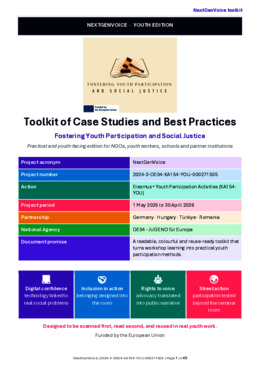
NextGenVoice Toolkit: Youth Participation and Social Justice in Practice
A practical Erasmus+ toolkit with tested youth work methods on digital confidence, inclusion, human rights, advocacy, civic participation and Street Action.
Aims of the tool
The aim of this tool is to support youth workers, NGOs, schools and partner institutions in designing inclusive, youth-led activities that strengthen participation, social justice, European citizenship and public voice.
It helps facilitators turn workshop learning into practical action by offering transferable methods, case studies, reflection tools and examples tested across four national workshops in Germany, Hungary, Türkiye and Romania.
The tool aims to:
- develop young people’s confidence to participate in democratic and community life;
- connect digital skills with real social problems and youth-led solutions;
- promote inclusion, equality, belonging and social justice in youth work;
- translate human rights and advocacy language into practical campaigns and public narratives;
- encourage young people to test participation beyond the seminar room through Street Action and community engagement;
- support organisations in adapting tested Erasmus+ methods to their own local context.
Description of the tool
NextGenVoice Toolkit: Youth Participation and Social Justice in Practice is a practical, youth-facing learning tool created within the Erasmus+ project Fostering Youth Participation and Social Justice – NextGenVoice, project number 2024-3-DE04-KA154-YOU-000271505.
The toolkit documents and transforms the learning process of four international workshops into reusable youth work methods. It was designed for NGOs, youth workers, schools, facilitators, mixed student groups and partner institutions that want to strengthen youth participation, inclusion, social justice and European citizenship through non-formal education.
The tool is organised around four core learning areas:
Digital confidence – helping young people use technology, digital collaboration and innovation in relation to real social challenges, not only as technical skills.
Inclusion in action – supporting facilitators to design learning spaces where belonging, equality, gender awareness, cultural sensitivity and participation are built into the room.
Rights to voice – helping young people understand human rights, social justice and advocacy by translating rights language into public narrative, campaign messages and local action.
Street Action and civic participation – encouraging young people to move beyond discussion and test participation in public spaces, community settings and future project routes.
The toolkit includes case studies, best practices, workshop reflections, practice stories, partner follow-up notes, transferability ideas and annex-based practical tools. It was written to be scanned first, read second and reused in real youth work. Its visual and practical structure makes it easier for young readers and facilitators to identify activities that can be adapted to their own group.
The learning outcomes of the tool include:
- participants understand different forms of youth participation and civic engagement;
- participants can identify local social justice issues and connect them with European citizenship values;
- participants improve confidence in public speaking, teamwork, advocacy and campaign design;
- participants learn how digital tools can support participation, inclusion and social impact;
- participants explore how to make learning spaces more inclusive and sensitive to cultural, gender, religious and language diversity;
- participants develop practical ideas for youth-led community actions, campaigns or follow-up projects;
- facilitators gain a tested framework for adapting activities to different national, cultural and organisational contexts.
The tool is especially useful for Erasmus+ Youth Participation Activities, youth exchanges, local youth meetings, training courses, seminars, civic education workshops, NGO capacity-building activities and school-based democratic participation programmes.
Available downloads:
Disclaimer
SALTO cannot be held responsible for the inappropriate use of these training tools. Always adapt training tools to your aims, context, target group and to your own skills! These tools have been used in a variety of formats and situations. Please notify SALTO should you know about the origin of or copyright on this tool.
Tool overview
http://toolbox.salto-youth.net/5665
This tool is for
Young people aged 16+, youth workers, NGO staff, facilitators, trainers, teachers, student groups, local youth councils, youth-led organisations and partner institutions interested in participation, social justice, inclusion and European citizenship. The tool is suitable for mixed international groups, local youth groups, beginners in civic participation, and young people with different levels of confidence in English, digital skills or public speaking.
and addresses
European Citizenship
It is recommended for use in:
Transnational Youth Initiatives
Materials needed:
Printed or digital version of the NextGenVoice Toolkit;
projector or screen for presentations;
flipcharts, markers, sticky notes and pens;
laptops, tablets or smartphones for digital collaboration activities;
internet connection, especially for digital participation or campaign design tasks;
printed handouts from the toolkit annexes;
open space for group work, movement debates and reflection activities;
optional public or community space for Street Action activities;
consent forms and safeguarding procedures when using photos, videos or public-facing dissemination.
Duration:
The tool can be used flexibly.
A short activity based on one toolkit method can take 30–60 minutes.
A half-day workshop can take 3–4 hours and may include one theme, such as inclusion, digital participation or campaign design.
A full training day can take 6–7 hours, combining group building, thematic input, case study work, practical planning and reflection.
A complete learning process can be delivered across 2–5 days, using several toolkit chapters and ending with a youth-led action plan, campaign idea, public presentation or Street Action.
Suggested training process:
Introduction and group building
Participants explore the topic of youth participation, European citizenship and social justice through an interactive opening activity.
Theme exploration
The facilitator selects one of the toolkit areas: digital confidence, inclusion, human rights advocacy or Street Action. Participants discuss real issues from their own communities.
Case study work
Participants examine one of the workshop examples from Germany, Hungary, Türkiye or Romania and identify what could be transferred to their own context.
Practical group task
Small groups design a campaign, digital solution, inclusion strategy, advocacy message or public-space action.
Presentation and peer feedback
Groups present their ideas and receive structured feedback from peers and facilitators.
Reflection and transfer
Participants reflect on what they learned, what they can use locally and what support they need to continue.
Follow-up action planning
Participants define small realistic next steps, such as a local awareness activity, online campaign, school discussion, youth consultation or NGO initiative.
Behind the tool
The tool was created by
This tool was created within the Erasmus+ project Fostering Youth Participation and Social Justice – NextGenVoice as a practical and transferable toolkit based on the methodology, implementation and reflection process of four national workshops. The part
in the context of
NextGenVoice project partnership Lead partner: Phoenix Knowledge Wings gGmbH, Germany Partner organisations: Creative Youth Academy Hungary, Hungary ERFEY Bilisim ve Danismanlik, Türkiye SKILLHUB Inclusivity, Romania Copyright owner: NextGenVoice proje
The tool has been experimented in
The tool was experimented in a series of Erasmus+ youth participation workshops, partner review meetings, non-formal learning sessions, group-building activities, simulations, campaign design workshops, inclusion exercises, digital collaboration sessions,
The tool was published to the Toolbox by
Daniela Alexeiciuc (on 18 May 2026)
and last modified
7 May 2026
Comments
No comments have been posted yet.
If you want to comment on this tool, you need to be signed in with your MySALTO account. Sign in now