Toolbox — For Training and Youth Work
All new tools in your inbox: Be the first to know about new tools for learning with our e-mail notifications.
Group Building Activity
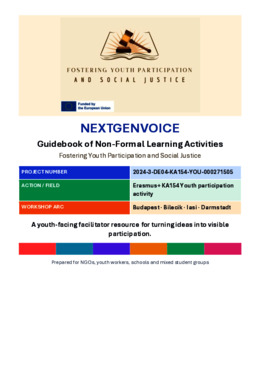
NextGenVoice Guidebook of Non-Formal Learning Activities: Fostering Youth Participation and Social Justice
A practical facilitator guide with 19 non-formal learning activities that help young people turn ideas into visible participation, advocacy, inclusion, digital action and social justice initiatives.
Aims of the tool
The tool aims to support youth workers, NGOs, schools and mixed student groups in designing energetic, inclusive and youth-led learning activities. It helps participants explore identity, civic engagement, digital transformation, social inclusion, human rights and community action, while developing practical skills for advocacy, cooperation, public voice and democratic participation.
Description of the tool
The NextGenVoice Guidebook of Non-Formal Learning Activities is a youth-facing facilitator resource created within the Erasmus+ KA154 Youth Participation Activity project “NextGenVoice”. It brings together reusable methods tested and developed through workshops in Budapest, Bilecik, Iasi and Darmstadt.
The guidebook contains 19 selected non-formal learning activities organised around several learning strands: civic engagement and community leadership, digital transformation, social inclusion, human rights, cross-cutting care and supplementary practice. Each activity is presented in a clear facilitator format, including purpose, group size, duration, space, materials, language load, step-by-step process, adaptation tips, debriefing questions and project value.
The tool is designed for action rather than passive reading. It supports facilitators in choosing an activity, reading the needs of the group, adjusting the level of visibility and helping participants leave with something concrete: a message, campaign idea, prototype, wall output, public action concept or shared reflection.
The guidebook encourages gradual participation. It starts from safer formats such as pairs, trios, visual work, guided observation and small-group discussion, and only then moves towards public speaking, advocacy, outdoor activities or role-play. This makes the tool especially useful for mixed groups, international youth groups, participants with different language levels and young people who may need more time before speaking in plenary.
Expected learning outcomes include:
Participants will be able to identify local and social issues that affect young people and communities.
Participants will practise transforming personal experiences and community concerns into advocacy messages, campaign ideas and visible participation actions.
Participants will strengthen communication, teamwork, critical thinking and public expression skills.
Participants will explore human rights, inclusion, fairness, power relations, consent, social justice and youth participation through experiential methods.
Participants will become more confident in taking initiative, contributing to group decisions and proposing youth-led solutions.
Facilitators will gain a structured collection of adaptable non-formal learning activities that can be used in youth exchanges, seminars, school workshops, NGO trainings and local participation projects.
Available downloads:
Disclaimer
SALTO cannot be held responsible for the inappropriate use of these training tools. Always adapt training tools to your aims, context, target group and to your own skills! These tools have been used in a variety of formats and situations. Please notify SALTO should you know about the origin of or copyright on this tool.
Tool overview
http://toolbox.salto-youth.net/5669
This tool is for
Young people, youth workers, NGO staff, trainers, facilitators, teachers, school groups, student groups and mixed international youth groups. The tool is suitable for participants aged approximately 13+ and can be adapted for older youth, young adults and adult education contexts.
and addresses
Youth Initiatives
It is recommended for use in:
European Voluntary Service
Materials needed:
Depending on the selected activity, the materials may include A4 paper, flipchart paper, sticky notes, coloured markers, tape, whiteboard, printed prompt cards, short quotes, issue cards, campaign templates, internet-connected devices, projector, speakers, open wall space and optional outdoor observation space. Most activities can be implemented with simple low-cost materials.
Duration:
The guidebook is flexible and can be used for single activities, half-day sessions, full-day workshops or longer training programmes.
Individual activities usually last between 30 and 120 minutes. Examples include 30–45 minutes for short reflection and attention-shift activities, 45–75 minutes for discussion, identity, advocacy and digital collaboration activities, and 90–120 minutes for more complex role-play, forum theatre or public participation formats.
A recommended training flow is:
Start with trust-building and identity-based activities, such as Avatar and Identity Mapping.
Move into local issue exploration and group analysis, such as Community Issues to Advocacy Messages.
Add digital, inclusion or human rights activities according to the learning objective.
Support participants to create visible outputs: campaign messages, prototypes, public voice actions, resource walls or outreach plans.
Close with reflection, debriefing and transfer to participants’ local realities.
Behind the tool
The tool was created by
Phoenix Knowledge Wings gGmbH, together with the NextGenVoice project partnership: Creative Youth Academy Hungary, ERFEY Bilisim ve Danismanlik in Türkiye, and SKILLHUB Inclusivity in Romania.
in the context of
The tool was created within the Erasmus+ KA154 Youth Participation Activity project “NextGenVoice – Fostering Youth Participation and Social Justice”, project number 2024-3-DE04-KA154-YOU-000271505.
The tool has been experimented in
The tool and its activities were experimented in youth participation workshops, non-formal learning sessions, NGO learning contexts and mixed international youth group activities in Budapest, Bilecik, Iasi and Darmstadt.
The tool was published to the Toolbox by
Daniela Alexeiciuc (on 18 May 2026)
and last modified
7 May 2026
Comments
No comments have been posted yet.
If you want to comment on this tool, you need to be signed in with your MySALTO account. Sign in now