Toolbox — For Training and Youth Work
All new tools in your inbox: Be the first to know about new tools for learning with our e-mail notifications.
Report
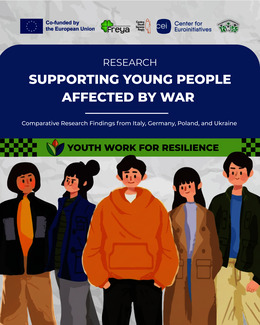
Comparative Analysis Report Research: “Supporting Young People Affected by War: Challenges, Needs and Responses”
Comparative research from Italy, Germany, Poland, and Ukraine exploring the challenges, needs, and effective youth work responses for young people affected by war, with practical findings on resilience, inclusion, and participation.
Aims of the tool
The research aims to strengthen the capacity of youth workers, youth organisations and other professionals to respond effectively to the needs of young people affected by war, with a specific focus on young people affected by the war in Ukraine, both within Ukraine and in European host countries.
More specifically, it aims to:
- identify the main challenges experienced by young people affected by war and the barriers limiting their participation and inclusion, particularly those resulting from the war in Ukraine, displacement and forced migration;
- explore the challenges faced by youth workers and organisations when supporting young people affected by war;
- identify the competencies, knowledge and support needed by youth workers to respond to emerging needs;
collect and analyse promising youth work practices that strengthen resilience, participation, inclusion and psychosocial wellbeing;
- identify possible approaches and priorities for future youth work interventions, training and capacity-building activities;
- provide an evidence base for developing more inclusive, trauma-informed and context-sensitive youth work practices.
The research also encourages reflection on how the consequences of war affect young people differently in countries experiencing active armed conflict and in host countries receiving refugees and displaced young people. The war in Ukraine serves as the central context of the research, allowing comparison between the experiences of young people living in an active-war environment in Ukraine and those who have been displaced to Germany, Italy and Poland or are living in communities affected by these displacement processes.
Description of the tool
“Supporting Young People Affected by War: Challenges, Needs and Responses” is a comparative research report developed within the Erasmus+ KA2 Capacity Building project “Youth Work for Resilience.”
The research was conducted in Italy, Germany, Poland, and Ukraine from March to May 2026 and brings together quantitative, qualitative, and practice-based evidence on youth work with young people affected by war. While the research considers the broader impact of armed conflict on youth work, it has a particular focus on the consequences of the war in Ukraine and on the experiences of young people affected by this war in Ukraine and across European host countries.
Within the research, young people affected by war refers broadly to young people aged approximately 13–30 whose wellbeing, opportunities, development or participation have been directly or indirectly influenced by armed conflict. This includes young people living in active-war contexts, refugees and internally displaced young people, young people with conflict-related migration experiences, as well as young people in host communities affected by changing social dynamics and pressures on local services.
The research therefore considers several interconnected realities: young people continuing to live in Ukraine under conditions of war, insecurity and disruption; internally displaced young people within Ukraine; young Ukrainians who have been forced to relocate to other European countries; and young people in host communities whose lives and social environments have also been influenced by displacement and the wider consequences of the war.
The research used a mixed-methods approach combining:
- a comparative survey with youth workers, youth leaders, educators, trainers, psychologists, social workers and representatives of youth organisations, youth centres, schools, municipalities and other actors working with young people;
- focus group discussions in all four partner countries to explore the experiences behind the survey findings and better understand country-specific realities;
- a collection of youth work practices demonstrating concrete methods and approaches used to strengthen resilience, participation, inclusion and psychosocial wellbeing.
The publication examines four interconnected areas:
1. Challenges faced by youth workers and organisations, including psychosocial, professional, organisational and contextual challenges.
2. Challenges and barriers faced by young people, particularly those affecting participation, inclusion, access to opportunities and community life.
3. Existing youth work practices and approaches that can support resilience, participation, belonging and wellbeing.
4. Possible intervention and capacity-building priorities for future youth work programmes and projects.
The comparative perspective makes it possible to explore both common patterns and important differences between countries. In Ukraine, youth work takes place in the context of an ongoing war, insecurity, displacement and disruption of everyday life. In Germany, Italy and Poland, youth workers are more frequently responding to issues connected with displacement, integration, adaptation and participation in host communities, particularly in relation to young people from Ukraine.
The research is intended not only as a source of information but also as a learning and reflection resource for youth workers, trainers, organisations and institutions. Its findings can be used when designing training programmes, planning youth activities, developing organisational strategies or discussing how youth work can respond to the long-term consequences of war and displacement. It can be particularly useful for practitioners and organisations working with Ukrainian young people, whether in Ukraine or in host-country settings.
After engaging with the publication, readers should be better able to:
- recognise the different ways in which war and displacement can affect young people's wellbeing, participation, social relationships and opportunities, with particular attention to the consequences of the war in Ukraine;
- identify key barriers preventing young people affected by war from participating in youth work and community life;
- understand the main professional and organisational challenges youth workers encounter when responding to war-related needs;
- distinguish between challenges that are shared across countries and those connected to specific national and local contexts;
- better understand the differences between supporting young people in an active-war context in Ukraine and supporting displaced Ukrainian young people in host countries;
- reflect on the competencies and support systems youth workers need when working with young people affected by war;
- identify principles and practices that can contribute to more inclusive, participatory, resilience-oriented and trauma-informed youth work;
- draw inspiration from existing youth work practices and consider how their transferable elements could be adapted to other contexts;
- use research evidence when designing youth work activities, training programmes and capacity-building initiatives;
- reflect critically on how youth work can contribute to resilience, social cohesion, participation and a sense of belonging among young people affected by war.
The Report is available for download on the website of the project: https://freya.org.pl/wp-content/uploads/2026/08/COMPARATIVE-ANALYSIS-REPORT.pdf
The project page: https://freya.org.pl/projekt/youth-work-for-resilience/
The publication was developed within the Erasmus+ project “Youth Work for Resilience” by:
- Wrocław Foundation for European Education and International Cooperation FREYA, Poland;
- Centro Studi Sereno Regis ODV, Italy;
- pewobe g GmbH in Frankfurt (Oder), Germany;
- Center for Euroinitiatives, Ukraine.
The project is supported by the Foundation for the Development of the Education System – National Agency for the Erasmus+ Programme and the European Solidarity Corps.
Disclaimer
SALTO cannot be held responsible for the inappropriate use of these training tools. Always adapt training tools to your aims, context, target group and to your own skills! These tools have been used in a variety of formats and situations. Please notify SALTO should you know about the origin of or copyright on this tool.
Tool overview
http://toolbox.salto-youth.net/5968
This tool is for
The publication is particularly relevant for: - youth workers and youth leaders; - trainers and facilitators in non-formal education; - youth organisations and youth centres; - educators and teachers working with young people affected by war or displacement; - professionals working directly with young people affected by the war in Ukraine, both inside Ukraine and in European host countries; - professionals working with refugees and internally displaced young people; - social workers, psychologists and other professionals cooperating with the youth sector; - representatives of municipalities and public institutions responsible for youth policy and youth services; - Erasmus+ and European Solidarity Corps project coordinators and practitioners; - organisations developing programmes on resilience, inclusion, participation, social cohesion and trauma-informed youth work; - researchers, policymakers and decision-makers interested in youth work responses to war, displacement and forced migration. The resource can be useful both for practitioners working directly in contexts affected by armed conflict and for those supporting refugees, displaced young people and host communities in other European countries.
and addresses
Social Inclusion, Intercultural Learning, Conflict Management, Youth Participation
It is recommended for use in:
Capacity Building
Behind the tool
The tool was created by
Wrocław Foundation for European Education and International Cooperation FREYA, Poland; Centro Studi Sereno Regis ODV, Italy; pewobe g GmbH in Frankfurt (Oder), Germany; Center for Euroinitiatives, Ukraine.
in the context of
The comparative research report developed within the Erasmus+ KA2 Capacity Building project “Youth Work for Resilience.”
The tool was published to the Toolbox by
Yuliya Ielfimova (on 28 August 2026)
and last modified
26 August 2026
Comments
No comments have been posted yet.
If you want to comment on this tool, you need to be signed in with your MySALTO account. Sign in now