Toolbox — For Training and Youth Work
All new tools in your inbox: Be the first to know about new tools for learning with our e-mail notifications.
Manual
CliMates
CliMates: bilingual English-Greek guide for youth workers, with hands-on climate workshops, field activities and digital tools to help young people learn, reflect and take action.
Aims of the tool
The CliMates guide aims to help youth workers:
- Explain climate change in accessible language and help young people distinguish evidence from assumptions.
- Facilitate inclusive workshops that connect climate change with everyday choices about food, water, waste and transport.
- Use field observation, citizen science and digital tools to investigate local environmental issues.
- Support young people in designing a realistic climate action for their community, identifying who can help and how to assess progress.
- Adapt the activities to different groups and use reflection and Youthpass to help participants recognise what they have learned.
Description of the tool
CliMates is a 93-page bilingual guide for youth workers, trainers and non-formal educators who want to explore climate change with young people. Each activity is presented first in English and then in Greek. Workshops are organised by title, so facilitators can select a single exercise or combine several to suit their group, setting and available time.
The guide connects climate science with questions young people can investigate for themselves. In *Food Miles*, teams trace the journey of a food product and distinguish what its label tells them from what they still need to find out. In the Athens Climate Mission, they compare two public spaces, document shade, accessibility, transport and waste facilities, and use their observations to propose improvements. Both activities can be adapted to another town or community. Other workshops use theatre to model the greenhouse effect, Pl@ntNet to explore local biodiversity, and role play to negotiate how a coastal city could spend a limited adaptation budget.
Facilitators will find step-by-step instructions, timings, printable cards, worksheets and links to digital tools. The guide also includes energisers, a trust-building exercise, a closing reflection and evaluation questions ready to copy into Google Forms.
Learning outcomes
Depending on the activities selected, participants will be able to:
- Distinguish weather from climate, explain the enhanced greenhouse effect in their own words, and give a local example of mitigation or adaptation.
- Record a field observation, separate evidence from interpretation, and identify what further information they need before drawing a conclusion.
- Compare food, water, waste or transport choices using more than one criterion and explain a trade-off.
- Use a digital tool to communicate a finding through a labelled concept map, a captioned photograph or a plant observation that records uncertainty.
- Work with others to design a feasible local climate action, identify who needs to be involved and agree on a first step.
- Adapt a workshop for their own youth group and describe a concrete example of their learning through reflection or Youthpass.
Disclaimer
SALTO cannot be held responsible for the inappropriate use of these training tools. Always adapt training tools to your aims, context, target group and to your own skills! These tools have been used in a variety of formats and situations. Please notify SALTO should you know about the origin of or copyright on this tool.
Tool overview
http://toolbox.salto-youth.net/6186
This tool is for
Youth workers, trainers, facilitators and educators working with young people in non-formal settings. The guide is particularly suited to Erasmus+ youth activities and international groups. Individual workshops can be adapted for older teenagers and young adults with different language levels, access needs and prior knowledge of climate change.
and addresses
Environment
It is recommended for use in:
Training and Networking
Materials needed:
Materials depend on the workshop selected. For most activities, you will need A3 or flipchart paper, markers, pens, sticky notes and printed copies of the relevant cards or worksheets from the guide.
Digital activities: One internet-connected smartphone, tablet or laptop per team. A projector and speakers are useful for shared videos and quizzes.
-Fieldwork: A notebook or observation sheet and a phone with a camera. For plant identification, install the free Pl@ntNet app. Teams can take photos offline and identify plants later.
Food and waste workshops: Clean food packaging with readable labels, reusable containers and everyday objects that can be repaired or reused. Photos can substitute for physical items.
Concept mapping and simulations: Paper or digital maps, printed role cards and the decision sheets provided in the guide.
Duration:
Duration and training process
The CliMates training course ran over seven working days, excluding arrival and departure days. The guide brings together the course materials, alternative workshops and additional activities for future use. Facilitators can select activities to suit their group and available time.
The training process moves from group building and climate literacy to hands-on workshops, field observation and collaborative action planning. It closes with reflection and evaluation. Energisers take 5–7 minutes, most workshops take 30–90 minutes, and an extended field visit can take a full day.
Behind the tool
The tool was created by
Ioanna Ntinou Young Active Eurocitizens) developed the educational content of the CliMates guide with support from ChatGPT (OpenAI) in drafting, organising and translating the material for the English–Greek edition.
in the context of
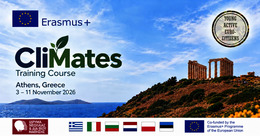
The guide was developed as part of CliMates, an Erasmus+ training course for youth workers (KA153-YOU, project no. 2025-3-EL02-KA153-YOU-000373139), coordinated by Young Active Eurocitizens. Held in Athens, Greece, from 3 to 11 November 2026, the course b
The tool has been experimented in
Selected activities from the guide were used during the CliMates Erasmus+ training course for youth workers in Athens and the Lavreotiki area, Greece (3–11 November 2026). These included workshops on food miles and food waste, urban field observations in
The tool was published to the Toolbox by
IOANNA NTINOU (on 20 November 2026)
and last modified
15 November 2026
Comments
No comments have been posted yet.
If you want to comment on this tool, you need to be signed in with your MySALTO account. Sign in now