Toolbox — For Training and Youth Work
All new tools in your inbox: Be the first to know about new tools for learning with our e-mail notifications.
Simulation Exercise, Exercise, Presentation, Manual, Ice-breaker, Group Building Activity
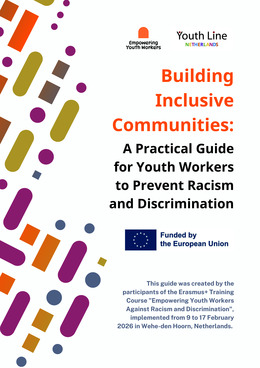
Building Inclusive Communities: A Practical Guide for Youth Workers to Prevent Racism and Discrimination
A practical guide provides youth workers with practical methods, communication tools, reflection activities and non-formal education techniques to prevent racism, discrimination and social exclusion while promoting inclusive youth work.
Aims of the tool
To strengthen the competences of youth workers in preventing racism and discrimination through non-formal education, while promoting inclusion, diversity, intercultural dialogue, human rights and respectful communication. The guide provides practical methods, activities and tools that can be directly used in everyday youth work to create safer, more inclusive and participatory learning environments. It also aims to support the exchange of good practices and encourage the use of innovative educational approaches across different youth work settings.
Description of the tool
This practical guide was developed by the participants of the Erasmus+ Training Course "Empowering Youth Workers Against Racism and Discrimination" (Project No. 2025-1-NL02-KA153-YOU-000300619), held in Wehe-den Hoorn, Netherlands, from 9 to 17 February 2026.
The publication brings together the knowledge, practical methods and experiences developed during the training course and the online follow-up activities. It is designed for youth workers, trainers, educators, volunteers and youth organisations that want to create more inclusive learning environments and respond effectively to racism, discrimination and social exclusion.
The guide combines short theoretical explanations with practical tools that can be immediately adapted to local and international youth work. It includes topics such as understanding discrimination, recognising early warning signs, responding to difficult situations, Nonviolent Communication (NVC), conflict resolution, inclusive facilitation, group dynamics, reflection methods, ice-breakers, group activities, case studies and personal action planning.
After using this guide, learners will be able to:
recognise different forms of racism and discrimination;
identify early signs of exclusion within youth groups;
respond to challenging situations using respectful and constructive communication;
apply the basic principles of Nonviolent Communication (NVC);
facilitate more inclusive and participatory youth activities;
strengthen group cohesion and create safer learning environments;
use practical non-formal education methods to promote equality, diversity and human rights;
reflect on their own practice and develop concrete actions to improve their everyday youth work.
The guide is intended as a practical resource rather than a theoretical publication. All activities and methods can be adapted to different countries, organisations and target groups, making it suitable for local youth work, Erasmus+ projects, training courses, youth exchanges and community initiatives.
Disclaimer
SALTO cannot be held responsible for the inappropriate use of these training tools. Always adapt training tools to your aims, context, target group and to your own skills! These tools have been used in a variety of formats and situations. Please notify SALTO should you know about the origin of or copyright on this tool.
Tool overview
http://toolbox.salto-youth.net/5853
This tool is for
Youth workers, youth leaders, trainers, facilitators, educators, NGO staff, volunteers, youth organisations, community workers, project coordinators, youth mentors, and anyone working with young people in formal or non-formal education.
and addresses
Social Inclusion, Anti-Racism, Group Dynamics, Intercultural Learning, Conflict Management
It is recommended for use in:
Training and Networking
Materials needed:
Most activities in this guide require only basic materials that are commonly available in youth work settings. Depending on the activity, you may need:
Printed copies of worksheets or reflection questions
Flipchart paper or whiteboard
Markers and pens
Sticky notes
A4 paper
Name tags (optional)
Projector and laptop (optional, for presentations)
Internet access (optional, for online resources and videos)
Chairs and open space for group activities and role plays
The activities are designed to be flexible and can be adapted to different learning environments with minimal resources.
Duration:
The guide is flexible and can be used in different ways depending on the learning objectives and available time.
Individual chapters can be used as 15–30 minute learning sessions or discussion starters.
Practical activities, reflection exercises and case studies usually take 30–90 minutes.
A workshop based on one chapter can be delivered in 2–3 hours.
Several chapters can be combined to create a one-day (6–8 hours) or two-day training programme.
The complete guide can be integrated into a 5–7 day Erasmus+ training course, youth exchange or a longer capacity-building programme.
The publication is designed as a modular resource, allowing facilitators to select and adapt individual chapters, activities and methods according to the needs, experience level and learning objectives of their participants.
Behind the tool
The tool was created by
Youth Line Netherlands
in the context of
This guide was created as one of the main educational outcomes of the Erasmus+ Training Course "Empowering Youth Workers Against Racism and Discrimination" (Project No. 2025-1-NL02-KA153-YOU-000300619), organised by Youth Line Netherlands in Wehe-den Hoor
The tool was published to the Toolbox by
Kateryna Shepeliuk (on 10 July 2026)
and last modified
9 July 2026
Comments
No comments have been posted yet.
If you want to comment on this tool, you need to be signed in with your MySALTO account. Sign in now