Toolbox — For Training and Youth Work
All new tools in your inbox: Be the first to know about new tools for learning with our e-mail notifications.
Manual
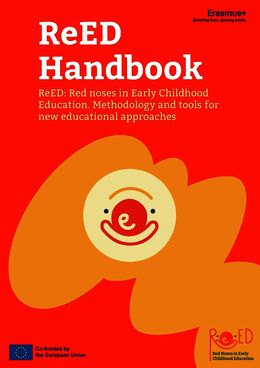
ReED Handbook
ReED handbook combining clown pedagogy and early childhood education: practical methodology with ready-to-use sessions, activities and downloadable cards. Inspires volunteers, youth workers and trainers running inclusive SEL-focused play with children.
Aims of the tool
The aim of the ReED handbook is to provide a practical, ready-to-adapt methodology—rooted in clown pedagogy and embodied play—to help educators and facilitators design inclusive activities for young children that strengthen social-emotional learning, positive group dynamics, and relationships. It also aims to support collaboration with families through simple take-home tools and a replicable parental-engagement micro-event.
Description of the tool
ReED: Red Noses in Early Childhood Education – Handbook is a practical learning resource that translates clown pedagogy and body-based play into inclusive educational activities for children (3–6 years), with a strong focus on social-emotional learning (SEL) and relationship-building. It is designed as a ready-to-use and adaptable toolkit: it explains the ReED methodology (principles and facilitation stance), provides 8 downloadable classroom sessions, includes guidelines to run a small parental-engagement micro-event, and offers simple “home tools” that can be shared with families.
The handbook was created primarily for ECEC teachers educators and parents, but it can also inspire young people, youth workers and trainers who design inclusive, play-based activities for children in non-formal settings (youth centres, after-school programmes, camps, libraries and community spaces). The approach is deliberately low-threshold, low-resource and non-verbal, making it easier to adapt across languages, cultures, abilities and mixed groups.
What learners will do with this tool
Learners explore a clear but flexible session structure (warm-up → playful embodied activities → calm/reflection), practise facilitating with a “clown mindset” (curiosity, listening, welcoming mistakes), and use simple reflection tools (e.g., observation prompts) to adapt activities to real group needs. They can also learn how to design a short, replicable micro-event to involve parents/caregivers and strengthen the school/community link.
Learning outcomes
After using the handbook, learners (young people, youth workers, trainers) will be able to:
Design and facilitate inclusive, play-based sessions for children using movement, rhythm, imitation and simple theatrical/clown elements.
Apply core ReED principles in practice: body as a language of inclusion, humour as a bridge to learning, trust in process, error as a resource, reciprocal listening, flexible participation, care and tenderness.
Support children’s socio-emotional development (emotional expression, empathy, cooperation, resilience, self-confidence, belonging) through structured activities that can be integrated into everyday routines.
Use non-verbal communication intentionally to reduce language barriers and include children with different linguistic backgrounds, temperaments or support needs.
Plan and deliver a parental-engagement micro-event (short, meaningful, replicable) and provide families with take-home “play impulses” that reinforce SEL at home.
Reflect on and improve their facilitation using observation/documentation prompts (what worked, inclusion adjustments, children’s responses), strengthening their capacity to adapt responsibly to different contexts.
Available downloads:
Disclaimer
SALTO cannot be held responsible for the inappropriate use of these training tools. Always adapt training tools to your aims, context, target group and to your own skills! These tools have been used in a variety of formats and situations. Please notify SALTO should you know about the origin of or copyright on this tool.
Tool overview
http://toolbox.salto-youth.net/5476
This tool is for
Youth workers, young people, volunteers and educators who wish to organise activities with children or in intergenerational settings.
and addresses
Social Inclusion, Group Dynamics, Personal Development
It is recommended for use in:
Training and Networking
Capacity Building
Behind the tool
The tool was created by
ReED project consortium: Teatro C’art Comic Education APS (Italy), Istituto Comprensivo di Castelfiorentino (Italy), Pestalozzi-Fröbel-Haus (Germany) and Akata Makata (Greece).
in the context of
The tool was created within the Erasmus+ KA210 small scale partnership project “ReED – Red Noses in Early Childhood Education”, through an international co-creation process between ECEC professionals and performing-arts trainers
The tool has been experimented in
classrom, Events involving children, families and the wider educational community. To download the tool in EN/IT/DE/EL https://teatrocart.com/formazione/progetti-sociali/scuole/progettoreed/
The tool was published to the Toolbox by
Francesca Frassetto (on 24 February 2026)
and last modified
23 February 2026
Comments
No comments have been posted yet.
If you want to comment on this tool, you need to be signed in with your MySALTO account. Sign in now