Toolbox — For Training and Youth Work
All new tools in your inbox: Be the first to know about new tools for learning with our e-mail notifications.
Manual
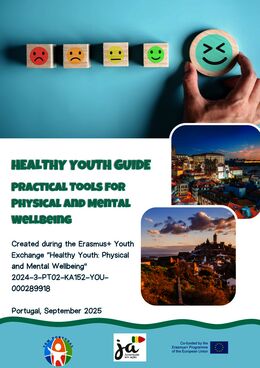
Healthy Youth Guide: A Practical Resource for Promoting Physical and Mental Wellbeing Among Young People
A practical guide created during an Erasmus+ Youth Exchange, offering tools and exercises to promote physical and mental wellbeing, inclusion, digital balance and sustainability among young people and youth workers.
Aims of the tool
The aim of the Healthy Youth Guide is to provide a practical, youth-friendly resource that supports physical and mental wellbeing and promotes inclusion of marginalised young people.
The guide brings together simple tools, exercises and reflection methods developed during the Erasmus+ Youth Exchange “Healthy Youth: Physical and Mental Wellbeing”. It helps young people and youth workers:
- understand the link between physical health, emotional balance and daily habits;
- manage stress through breathing, mindfulness and grounding techniques;
- recognise signs of burnout and build healthy routines;
- create safe and inclusive spaces by challenging stereotypes and addressing barriers to participation;
- connect wellbeing with sustainability through nature-based reflection and green habits;
- improve digital wellbeing through healthier online habits and boundaries;
- transfer learning into action through personal wellbeing plans and inclusive community initiatives.
The guide is designed for easy use in youth work settings (youth centres, schools, local workshops, peer groups) and as an open-access resource that can be adapted and shared.
Description of the tool
The Healthy Youth Guide is a practical learning resource developed during the Erasmus+ Youth Exchange “Healthy Youth: Physical and Mental Wellbeing” implemented in Portugal in September 2025.
The guide was co-created by young people aged 18–23 from five European countries through non-formal learning activities, daily reflection sessions, peer discussions and experiential workshops. It reflects their shared learning process and focuses on two main themes of the project: physical and mental wellbeing, and inclusion of marginalised young people.
The tool combines theory with practical exercises. It includes:
- breathing and mindfulness techniques,
- grounding methods,
- stress and burnout awareness tools,
- reflection and journaling exercises,
- a personal wellbeing checklist,
- guidance on creating safe and inclusive spaces,
- strategies for challenging stereotypes and addressing barriers,
- outdoor and nature-based wellbeing practices,
- digital wellbeing and screen-time management tools,
- a personal wellbeing action plan template.
The guide is designed for use in youth exchanges, local youth initiatives, workshops, schools and youth centres. It can be adapted by youth workers and facilitators to different contexts and target groups.
Learning Outcomes
Through the development and use of this tool, participants and users can:
- understand the connection between physical and mental health;
- increase emotional awareness and stress-management skills;
- recognise early signs of burnout and develop healthier routines;
- strengthen empathy and inclusive communication skills;
- understand marginalisation and barriers faced by young people;
- promote safe and inclusive environments in youth settings;
- improve digital wellbeing and responsible online behaviour;
- connect sustainability and wellbeing through nature-based practices;
- develop action planning skills for personal and community wellbeing;
- strengthen intercultural understanding and European cooperation awareness.
The Healthy Youth Guide supports active youth participation, promotes shared European values such as equality, respect and non-discrimination, and contributes to the long-term impact of the Erasmus+ project beyond its lifetime.
Available downloads:
Disclaimer
SALTO cannot be held responsible for the inappropriate use of these training tools. Always adapt training tools to your aims, context, target group and to your own skills! These tools have been used in a variety of formats and situations. Please notify SALTO should you know about the origin of or copyright on this tool.
Tool overview
http://toolbox.salto-youth.net/5493
This tool is for
Primary target group: - Young people aged 16–30, especially those interested in improving their physical and mental wellbeing. - Young people with fewer opportunities, including those facing social, economic, geographical or psychological barriers. Secondary target group: - Youth workers and facilitators working in non-formal education. - Youth leaders, peer educators and volunteers. - Teachers and trainers interested in wellbeing and inclusion topics. The tool is suitable for use in youth exchanges, local youth initiatives, schools, community projects and informal peer-learning settings.
and addresses
Youth Initiatives, Intercultural Learning, Personal Development
It is recommended for use in:
Youth Exchanges
Materials needed:
The Healthy Youth Guide does not require special or expensive materials.
Basic materials:
- Printed or digital version of the guide
- Notebook or paper for reflection and journaling
- Pen or pencil
- Flipchart and markers (for group activities)
Optional materials (depending on the activity):
- Comfortable space for group discussion
- Outdoor space for nature-based reflection activities
- Internet access (for digital wellbeing discussions)
- Yoga mats or comfortable seating for mindfulness exercises
Most exercises are designed to be low-cost and adaptable to different environments, including youth centres, classrooms, outdoor settings or informal meeting spaces.
Duration:
The Healthy Youth Guide is a flexible tool that can be adapted to different timeframes.
Individual exercises (such as breathing techniques, grounding methods or reflection tools) can be implemented in short sessions of 10–30 minutes.
Thematic workshops based on one chapter (e.g. stress management, inclusion, digital wellbeing or nature-based reflection) can last between 60–120 minutes.
A structured wellbeing workshop using several sections of the guide can be delivered as a half-day (3–4 hours) or full-day programme.
The guide can also be integrated into a longer learning process, such as a youth exchange, training course or local youth project over several days.
Facilitators are encouraged to adapt the duration according to participants’ needs, group size and learning objectives.
Behind the tool
The tool was created by
Unknown.
(If you can claim authorship of this tool, please contact !)
The tool was published to the Toolbox by
Kateryna Shepeliuk (on 2 March 2026)
and last modified
2 March 2026
Comments
No comments have been posted yet.
If you want to comment on this tool, you need to be signed in with your MySALTO account. Sign in now