Toolbox — For Training and Youth Work
All new tools in your inbox: Be the first to know about new tools for learning with our e-mail notifications.
Group Building Activity
Games and Non-Formal Education: “The game of the goose” as a warmer and team building game
In the project “Change Mind” «Being young in the Covid-19 pandemic: Let's change your NEET status and mindset» 2021-1-EL02-KA153-YOU-000018851 we used the Italian version of “Gioco dell’oca”- The Game of the Goose as a warmer up and team building game.
Aims of the tool
The aim was to create teaching material for warming up, ice breaking, and team building during the implementation of projects Erasmus+ Training courses and Youth exchanges. Learning by playing is the motto of great educators of the past and current century.There are foundational thinkers who have built from Piaget’s theories that support this; educators like Montessori and Stanley Greenspan have recognized that the way to teach a child is through their own interests and developed concrete strategies to do so.
It is a way for a person to discover his characteristics and therefore useful for one’s personal development. A game is the same as freedom of actions and it emphasizes specific thinking. In other words, homo ludens becomes himself through personal experience. This is a brief discussion of Huizinga’s philosophy. It paved the way for foreign (Germanic) countries to develop a new branch of pedagogy – pedagogy through games, often offered as post-graduate studies. A game is the main (basic) way to express one’s activeness as it releases creativity, energy, and power. Therefore, a game has a hidden potential to “break” the pre-set structures and encourage innovation, which is not only necessary in daily life, but also in this current context. A game is one of the few human techniques that make it possible to change the elements of some specific situation to create something new and unknown, and to find solutions for “unsolvable” situations. A game also helps players to actively learn to adapt to the environment. It is a great opportunity to know better the other players as well as to create inclusiveness and friendship.
Description of the tool
Description: The Game of the Goose is a traditional board game, whose history is lost in antiquity; its first "official" documentation dates back to the sixteenth century, when Francesco I de Medici gave a version of it to Philip II of Spain.It is a path game, usually arranged in a spiral, suitable for all ages, in which only luck, with the roll of the dices, establishes the winner; it lends itself very well to reworking on different themes, with its special boxes, which are of advantage (the “geese”, the bridges) or obstacles (labyrinth, prison) to the players. As in the classic game, the player who arrives exactly at box 63 wins, and the back and forth of the last part of the course is the most exciting and fun part, where everyone actively participates and cheers. In the adapted version, the game is a metaphor for the path of young people to find their place in life; during the game, in fact, the comments were focussed on curricula, skills, competences, communication and networking skills.
Aims; Like all games, especially if played in groups, it arouses attention, team spirit, participation in the chance of one's own group and of others.
Participants: 35 divided in 6 groups
Time:30 minutes
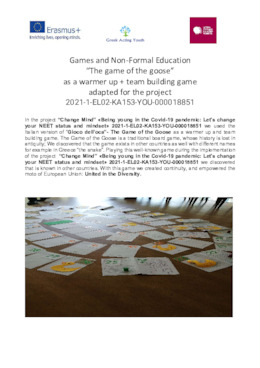
Tools: In the present project, a large path has been prepared, suitable
for the project work room, with all the numbered boxes, the placeholders in different colours and a clearly visible 7 cm x 7 wooden die. The boxes of the geese, which double the shot made, were highlighted by bright yellow ducks. All materials are re-used, and further recyclable.
The special boxes were designed according to the theme of the project, the NEET phenomenon and in particular:
- two labyrinths, where the young person, confused by the difficulties of orienting in the world of work or training, gets lost and stands still for a ride
- Three sofas, to recall the prejudice according to which NEETs would prefer to spend the day lying on the sofa, instead of taking initiatives: even here you must stop for a while
- The traditional prison has been replaced by a broken sofa: in that space you stop until another player arrives to free you, taking your place
- The bridges, which create opportunities for meeting (they are also a traditional symbol of Europe, appearing on euro banknotes) allow you to progress faster along the path, passing to specific more advanced boxes.
Available downloads:
Disclaimer
SALTO cannot be held responsible for the inappropriate use of these training tools. Always adapt training tools to your aims, context, target group and to your own skills! These tools have been used in a variety of formats and situations. Please notify SALTO should you know about the origin of or copyright on this tool.
Tool overview
http://toolbox.salto-youth.net/3332
This tool is for
This kind of game can be successfully used in Training courses and Youth exchange projects adapting the paths. Target group are trainers, youth workers, practitioners and organisations as they can use this kind of tool adapting it to their needs and obtaining successful results.
and addresses
YOUTH in ACTION (YiA) programme
It is recommended for use in:
Training and Networking
Materials needed:
Paper, marking pens : In the present project, a large path has been prepared, suitable
for the project work room, with all the numbered boxes, the placeholders in different colours and a clearly visible 7 cm x 7 wooden die. The boxes of the geese, which double the shot made, were highlighted by bright yellow ducks. All materials are re-used, and further recyclable.
Duration:
30 minutes
Behind the tool
The tool was created by
Maria Cristina Turola, Maria Kavouri
in the context of
Games and Non-Formal Education “The game of the goose” as a warmer up + team building game AND MORE…adapted for the project 2021-1-EL02-KA153-YOU-000018851
The tool has been experimented in
Training Course
The tool was published to the Toolbox by
Maria Kavouri (on 29 November 2022)
and last modified
15 September 2022
Comments
No comments have been posted yet.
If you want to comment on this tool, you need to be signed in with your MySALTO account. Sign in now