Toolbox — For Training and Youth Work
All new tools in your inbox: Be the first to know about new tools for learning with our e-mail notifications.
Manual
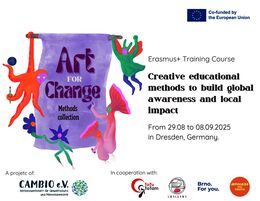
Art for Change - Methods Colleciton
A toolkit for youth workers seeking to integrate creative methods into their daily practice, offering concrete techniques ranging from land art and stop-motion video to performance art and upcycling workshops.
Aims of the tool
This resource embodies the project's core philosophy: that art is not merely an aesthetic exercise but a powerful medium for fostering empathy, critical thinking, and collective action on issues such as climate change, social inequality, and human rights. These methods were designed to be adaptable, inclusive, and accessible to practitioners with varying levels of artistic experience. They prioritize process over product, encouraging facilitators to create safe spaces where young people can explore complex topics emotionally and intellectually. By documenting these approaches, we aim to contribute to the broader European youth work sector, supporting the ongoing evolution of non-formal education toward more transformative, sustainable, and socially engaged practices.
Description of the tool
The Methods Collection serves not only as a repository of techniques but as a structured framework for developing specific competencies in youth work. By engaging with the documented activities—ranging from Collage for Self-Discovery and Dream Journeys to Stop Motion Animation, Upcycling/Trash Fashion, and Embodied Performance Art—participants acquired a diverse set of knowledge, skills, and attitudes essential for modern Global Citizenship Education (GCED).
1. Creative Pedagogical Competence Participants developed the ability to translate abstract socio-ecological concepts (such as climate justice, consumerism, and human rights) into tangible, accessible artistic formats. Through the Collage and Upcycling modules, youth workers learned to facilitate critical reflection on material culture and environmental impact without relying on traditional didactic lectures. The Stop Motion and Performance Art sections equipped them with technical skills to guide young people in digital storytelling and bodily expression, enabling them to reach audiences who might disengage from text-heavy educational approaches.
2. Facilitation of Emotional and Somatic Learning A core outcome of the collection is the capacity to facilitate somatic and emotional engagement. Methods like the Dream Journey, Force of Attraction, and Hyper-Consciousness Meditation taught facilitators how to create safe spaces for vulnerability and self-reflection. Participants learned to guide groups in distinguishing between physical sensations and mental narratives, fostering a deeper level of self-awareness and empathy. This shifts the focus of youth work from purely cognitive understanding to holistic, embodied learning, allowing young people to process complex emotions related to global crises.
3. Collaborative and Intercultural Dialogue Skills The World Game and Group Coordination exercises within the collection enhanced participants' abilities to foster non-verbal communication and collective problem-solving. By practicing these methods, youth workers acquired the skills to manage diverse group dynamics, resolve conflicts through creative means, and build trust across cultural boundaries. The collection emphasizes that collaboration is not just about working together, but about creating a shared language through movement and art that transcends linguistic barriers.
4. Critical Thinking and Political Agency Through the integration of political art and activist methodologies (e.g., Trash Fashion Shows and Land Art), participants learned how to empower young people to become active agents of change. The collection demonstrates how artistic expression can be used to critique power structures, visualize data (as seen in the Fingerprint Map exercise), and mobilize communities. Youth workers gained the confidence to facilitate discussions that connect personal experiences with broader systemic issues, fostering a sense of political agency among young people.
5. Adaptability and Inclusivity The methods documented are designed to be highly adaptable, allowing facilitators to tailor activities to different age groups, cultural contexts, and ability levels. Participants learned to modify techniques—such as simplifying the Stop Motion process for younger children or adapting Embodied exercises for those with mobility challenges—ensuring that GCED remains inclusive. This flexibility is a critical skill for working in diverse European contexts where resources and participant profiles vary significantly.
6. Digital and Technical Literacy Specific modules, particularly Stop Motion Animation and Digital Storytelling, provided participants with practical technical skills. They learned how to use accessible digital tools to create high-quality media content, a competency increasingly vital for engaging digital-native youth. This technical literacy empowers youth workers to produce professional-grade outputs that can be used for advocacy and dissemination on social media platforms.
Available downloads:
Disclaimer
SALTO cannot be held responsible for the inappropriate use of these training tools. Always adapt training tools to your aims, context, target group and to your own skills! These tools have been used in a variety of formats and situations. Please notify SALTO should you know about the origin of or copyright on this tool.
Tool overview
http://toolbox.salto-youth.net/5551
This tool is for
- Youth Workers - Youth Leaders - Teachers - Activists - Artist
and addresses
Social Inclusion, Intercultural Learning, Personal Development, Youth Participation, Environment
Behind the tool
The tool was created by
CAMBIO e.V.
The tool was published to the Toolbox by
Lara Riboni (on 28 March 2026)
and last modified
26 March 2026
Comments
No comments have been posted yet.
If you want to comment on this tool, you need to be signed in with your MySALTO account. Sign in now