Toolbox — For Training and Youth Work
All new tools in your inbox: Be the first to know about new tools for learning with our e-mail notifications.
Exercise, Manual, Report, Group Building Activity
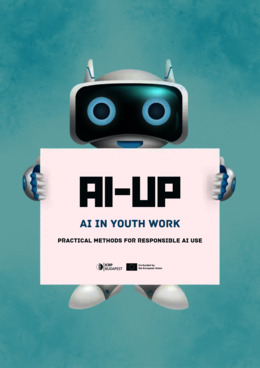
AI-UP - AI in youth work. Practical methods for responsible AI ise
A practical booklet for youth workers exploring AI for content creation, communication and project planning, with training methods, responsible-use guidance and examples of local activities from six countries.
Aims of the tool
The tool aims to strengthen youth workers’ practical AI competences and support the responsible use of AI in communication, content creation and project planning. It offers methods and examples that can be adapted to different target groups, while encouraging critical thinking, human oversight and the transfer of learning into local youth work practice.
Description of the tool
AI-UP: AI in youth work is a practical booklet developed through an Erasmus+ training course and follow-up activities involving organisations from Hungary, Finland, Türkiye, Armenia, Georgia and Ukraine.
It brings together training session descriptions, guidance on responsible AI use, practical examples and experiences of applying the learning in local communities. Topics include prompt writing, AI-assisted communication, text and visual content creation, video production, project development and workshop planning.
The booklet supports non-formal learning through practical experimentation, group work, peer feedback and reflection. Youth workers, trainers and educators can select activities and adapt them to their participants’ needs, digital experience and learning objectives. Examples from the follow-up activities illustrate applications in youth organisations, educational settings and creative and community work.
Responsible use runs throughout the resource, with attention to human oversight, checking AI-generated information, protecting personal data and recognising potential bias. The booklet encourages users to consider when AI is useful and how its outputs should be assessed before being shared or applied.
Expected learning outcomes
By working through selected activities and reflecting on their application, learners can:
- Explain practical opportunities and limitations of AI in youth work.
- Write and refine prompts that specify the task, context, target audience and desired output.
- Use AI to support communication materials, creative content, activity plans and project ideas.
- Critically assess AI-generated outputs for accuracy, relevance, bias and suitability for their target group.
- Apply responsible-use principles, including data protection, transparency and human accountability.
- Collaborate, exchange feedback and improve ideas through peer learning.
- Adapt methods to local needs and identify ways to transfer learning into everyday practice.
The outcomes depend on the activities selected and the time devoted to practice and reflection. The booklet can be used as a resource for facilitated workshops or for individual professional learning.
Available downloads:
Disclaimer
SALTO cannot be held responsible for the inappropriate use of these training tools. Always adapt training tools to your aims, context, target group and to your own skills! These tools have been used in a variety of formats and situations. Please notify SALTO should you know about the origin of or copyright on this tool.
Tool overview
http://toolbox.salto-youth.net/6054
This tool is for
Youth workers, trainers, facilitators, educators and NGO staff interested in using AI responsibly in non-formal education, communication and project planning. Activities can be adapted for young people and groups with different levels of digital experience.
and addresses
Project Management
It is recommended for use in:
Youth Exchanges
Training and Networking
Materials needed:
The AI-UP booklet, an internet-connected computer, tablet or smartphone, and access to the AI tools selected for the activities. For group workshops, a projector, paper, pens and sticky notes are useful. Some digital tools may require an account; facilitators should check access requirements in advance.
Duration:
Duration depends on the activities selected. A suggested format is 60–120 minutes for a focused workshop, with additional time for more complex content creation or project development. The booklet can also support a series of sessions.
The process combines a short introduction, practical experimentation with AI tools, individual or group tasks, peer feedback and reflection on responsible use and applications in youth work.
Behind the tool
The tool was created by
Institute for Cultural Relations Policy
in the context of
The booklet was created within “AI-UP: Harnessing Artificial Intelligence for Youth Work”, an Erasmus+ KA153 project coordinated by the Institute for Cultural Relations Policy. It draws on an international training course held in Fonyód, Hungary, from 30
The tool was published to the Toolbox by
Andras Lorincz (on 15 October 2026)
and last modified
10 October 2026
Comments
No comments have been posted yet.
If you want to comment on this tool, you need to be signed in with your MySALTO account. Sign in now