Toolbox — For Training and Youth Work
All new tools in your inbox: Be the first to know about new tools for learning with our e-mail notifications.
Simulation Exercise, Exercise, Manual
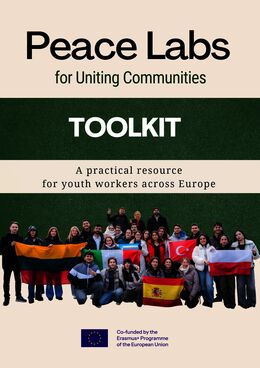
Peace Labs for Uniting Communities Toolkit
A practical toolkit with 10 tested non-formal education methods for dialogue, conflict transformation, depolarisation, cooperation and inclusive youth work in socially divided communities.
Aims of the tool
The Toolkit aims to support youth workers, trainers and facilitators in creating safe and inclusive spaces for dialogue, especially when working with young people affected by polarisation, conflict, social division or displacement.
It aims to:
- strengthen dialogue and facilitation skills;
- support conflict transformation and peaceful communication;
- develop empathy and understanding of different perspectives;
- help young people reflect on identity, inequality, conflict and cooperation;
- provide practical non-formal education methods that can be adapted to different youth work contexts;
- strengthen the capacity of youth organisations to address sensitive and divisive topics in a participatory way.
Description of the tool
The Peace Labs for Uniting Communities Toolkit is a practical learning resource developed for youth workers, trainers, facilitators and youth organisations working with diverse groups and communities affected by polarisation, conflict and social division.
The Toolkit contains 10 ready-to-use non-formal education methods. Each method includes objectives, expected learning outcomes, required materials, timing, step-by-step facilitation instructions, debriefing questions, adaptation suggestions and facilitator notes.
The methods are based on experiential learning. Participants first experience an activity, reflect on what happened, discuss different perspectives and connect the experience with their own lives, communities and youth work practice.
The expected learning outcomes include improved competences in dialogue facilitation, active listening, conflict transformation, cooperation, empathy, critical thinking, intercultural communication, group dynamics and the ability to work constructively with disagreement and sensitive topics.
The Toolkit was developed within the Erasmus+ project “Peace Labs for Uniting Communities” (2025-3-PL01-KA153-YOU-000373695), involving organisations from Poland, Lithuania, Türkiye, Spain, Italy and Greece. All ten methods were tested during the international training course and further refined afterwards.
Available downloads:
Disclaimer
SALTO cannot be held responsible for the inappropriate use of these training tools. Always adapt training tools to your aims, context, target group and to your own skills! These tools have been used in a variety of formats and situations. Please notify SALTO should you know about the origin of or copyright on this tool.
Tool overview
http://toolbox.salto-youth.net/6024
This tool is for
- Youth workers - Youth trainers and facilitators - Educators - Volunteers - Youth organisations - Community organisations - Young people, particularly those living in socially divided, polarised or conflict-affected communities - Groups including young people with fewer opportunities, migrants, displaced young people and minority communities The methods can be adapted to different age groups and levels of experience.
and addresses
Social Inclusion, Group Dynamics, Intercultural Learning, Personal Development, Conflict Management
It is recommended for use in:
Youth Exchanges
Training and Networking
Materials needed:
Each activity in the Toolkit contains its own detailed materials list.
Duration:
Most individual methods take approximately 45 minutes, although some can be extended depending on the size of the group and the depth of the debriefing.
Behind the tool
The tool was created by
Fundacja Instytut Partnerstwa Strategicznego, in cooperation with the partner organisations of the “Peace Labs for Uniting Communities” project: Lietuvos etnosporto komitetas, Genc Zihin Dernegi, La Casa Del Faro Aps, Asociación Cultural Maditerránea and
in the context of
The Toolkit was developed within the Erasmus+ KA153-YOU project “Peace Labs for Uniting Communities” (2025-3-PL01-KA153-YOU-000373695).
The tool has been experimented in
Training course for youth workers
The tool was published to the Toolbox by
Vladyslav Dementiev (on 28 September 2026)
and last modified
27 September 2026
Comments
No comments have been posted yet.
If you want to comment on this tool, you need to be signed in with your MySALTO account. Sign in now