Toolbox — For Training and Youth Work
All new tools in your inbox: Be the first to know about new tools for learning with our e-mail notifications.
Manual
Expressive Arts for marginalised communities
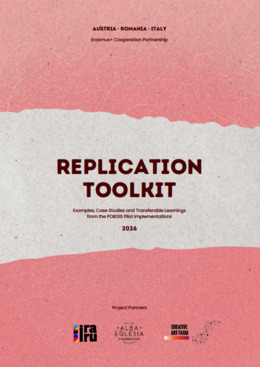
Replication toolkit for youth workers and organisations using arts to reach marginalised communities
Aims of the tool
The aim of the POIESIS Replication Toolkit is to provide accessible, practical resources that enable other organisations and cultural practitioners to replicate and adapt the project’s participatory Expressive Arts methodology in their own communities.
Description of the tool
POIESIS: Expressive Arts for Youths is an Erasmus+ learning and creative development project coordinated by IRARU. It uses expressive arts -including visual arts, music, movement, poetry, theatre, and other creative practices - as a way for young people with fewer opportunities to explore their creativity, express themselves, connect with others, and strengthen their emotional well-being.
The approach is based on learning through creative practice: participants are encouraged to experiment, create, reflect, and collaborate rather than focus only on achieving a predefined artistic result. Through participatory workshops and expressive arts activities, POIESIS creates safe spaces where young people can explore personal experiences, develop new perspectives, and build connections within their communities.
The project also develops a methodology, facilitator training, pilot workshops, and replication resources so that other organisations, artists, youth workers, and cultural practitioners can apply the approach with young people in different contexts.
By using the POIESIS Toolkit, users will be able to:
-Understand the principles and potential of expressive arts as a tool for youth work, inclusion, and well-being.
-Plan and facilitate creative activities using different expressive arts approaches.
-Create safe, inclusive, and supportive spaces where young people can express themselves freely.
-Adapt activities to the needs, interests, abilities, and cultural contexts of different groups of young people.
-Use creative methods to encourage self-expression, participation, communication, and connection.
-Support young people in exploring emotions, experiences, and ideas through artistic and creative practices.
-Facilitate reflection and dialogue before, during, and after creative activities.
-Encourage participation from young people with fewer opportunities and reduce barriers to engagement.
-Combine different artistic forms and methods to create meaningful and accessible learning experiences.
-Reflect on and evaluate their own facilitation practice and the impact of creative activities.
-Apply the POIESIS methodology in different youth work, educational, cultural, and community settings.
Available downloads:
Disclaimer
SALTO cannot be held responsible for the inappropriate use of these training tools. Always adapt training tools to your aims, context, target group and to your own skills! These tools have been used in a variety of formats and situations. Please notify SALTO should you know about the origin of or copyright on this tool.
Tool overview
http://toolbox.salto-youth.net/6002
This tool is for
Youth workers, cultural workers, social workers, community leaders, artists, facilitators, general public
and addresses
Social Inclusion, Intercultural Learning, Youth Participation
Behind the tool
The tool was created by
IRARU organisation in partnership with Creative Art Farm, Alba Eglesia Foundation. Document was written by Linda Velásquez Ramos. Supported by Bianca Scrugli, Irina Motrov, Octavian Anghelus, Ana Castro Villegas, María Fernanda Monasterio González (IRARU
The tool was published to the Toolbox by
IRARU IG- zur Förderung von Kultur (on 16 September 2026)
and last modified
14 September 2026
Comments
No comments have been posted yet.
If you want to comment on this tool, you need to be signed in with your MySALTO account. Sign in now