Toolbox — For Training and Youth Work
All new tools in your inbox: Be the first to know about new tools for learning with our e-mail notifications.
Manual
Voices of Europe: Youth Guide for Democracy and Inclusion
A practical guide created by young people during an Erasmus+ Youth Exchange, offering ideas and tools on democracy, inclusion, respectful dialogue, youth participation and turning learning into action.
Aims of the tool
The Voices of Europe: Youth Guide for Democracy and Inclusion aims to support young people and youth workers in understanding and practising democracy, inclusion and active participation in everyday life.
The guide aims to:
help young people better understand democracy and recognise their role in democratic and community life;
encourage meaningful youth participation and show different ways young people can make their voices heard;
raise awareness of barriers that can prevent young people, especially those with fewer opportunities, from participating;
promote inclusion, diversity and the involvement of voices that are often less represented;
strengthen active and empathic listening, respectful communication and dialogue between people with different perspectives;
help young people approach disagreement without increasing polarisation;
provide practical ideas for turning identified needs and ideas into small youth initiatives and local actions;
encourage the responsible use of digital tools for youth participation and civic engagement;
introduce Erasmus+ opportunities, Youth Exchanges and Youthpass as tools for learning and participation;
support young people in reflecting on their learning and transforming it into concrete follow-up actions in their communities.
Description of the tool
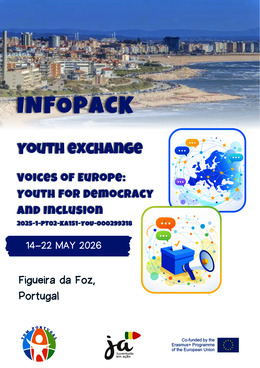
The Voices of Europe: Youth Guide for Democracy and Inclusion is a practical learning resource developed as a result of the Erasmus+ Youth Exchange “Voices of Europe: Youth for Democracy and Inclusion”, held in Figueira da Foz, Portugal, from 14 to 22 May 2026 (Project No. 2025-1-PT02-KA151-YOU-000299318).
The guide brings together the main topics, reflections and practical approaches explored by participants during the youth exchange. It was developed through a co-creation process in which participants reflected on their learning, identified key messages and contributed to the content and structure of the guide.
The resource focuses on democracy, youth participation, inclusion, diversity, dialogue and active citizenship. It explores what democracy means in young people’s everyday lives, different ways of participating, barriers that can prevent young people from being heard, and the importance of creating inclusive spaces.
A particular focus is placed on communication in democratic life. The guide introduces active and empathic listening, the difference between debate and dialogue, understanding different perspectives, respectful communication and ways of approaching disagreement without increasing polarisation. It also supports young people in moving from discussion to action by exploring how to identify an issue, develop a youth initiative, use digital tools for participation and connect civic participation with environmental responsibility.
The guide also introduces Erasmus+ opportunities, Youth Exchanges and Youthpass, encouraging young people to recognise their learning and continue participating after an international mobility experience.
Learning outcomes
By using the guide, learners can:
better understand democracy, active citizenship and youth participation;
recognise different ways young people can participate in democratic and community life;
identify social, economic, geographical and other barriers to participation;
understand the importance of inclusion, diversity and involving less represented voices;
develop greater awareness of active and empathic listening;
distinguish between debate and dialogue and understand their different purposes;
communicate opinions and disagreements in a more respectful and constructive way;
recognise the risks of polarisation and explore dialogue-based approaches to disagreement;
consider different perspectives without necessarily having to agree with them;
identify community issues and turn ideas into realistic youth actions;
understand how digital tools can support youth participation and civic engagement;
reflect on the connection between civic and environmental responsibility;
become more familiar with Erasmus+, Youth Exchanges and Youthpass;
reflect on personal learning and identify concrete follow-up actions.
The guide can be used individually or in group settings and is suitable for young people, youth workers, youth organisations, schools, youth centres and non-formal education activities. Its sections can be used independently or combined as part of workshops and discussions.
The overall purpose is to make the learning created during the youth exchange accessible beyond the direct participant group and provide other young people and youth workers with a reusable resource for promoting inclusive participation, respectful dialogue and active democratic engagement.
Available downloads:
Disclaimer
SALTO cannot be held responsible for the inappropriate use of these training tools. Always adapt training tools to your aims, context, target group and to your own skills! These tools have been used in a variety of formats and situations. Please notify SALTO should you know about the origin of or copyright on this tool.
Tool overview
http://toolbox.salto-youth.net/5960
This tool is for
Young people, youth workers, youth organisations, educators and facilitators interested in democracy, inclusion, active citizenship, dialogue and youth participation.
and addresses
Social Inclusion, Intercultural Learning, European Citizenship, Youth Democracy projects, Youth Participation
It is recommended for use in:
Youth Exchanges
Materials needed:
Digital or printed copy of the guide. For group activities, basic materials such as paper, pens, markers and access to a phone, tablet or computer can be useful.
Duration:
Flexible duration: 15–30 minutes for individual sections, or 1–2 hours for a facilitated group session. The full guide can also be used across several workshops, depending on the group’s needs and selected topics.
Behind the tool
The tool was created by
Associação TDM Portugal
in the context of
Erasmus+ Youth Exchange “Voices of Europe: Youth for Democracy and Inclusion”, Project No. 2025-1-PT02-KA151-YOU-000299318, held in Figueira da Foz, Portugal, 14–22 May 2026.
The tool was published to the Toolbox by
Kateryna Shepeliuk (on 21 August 2026)
and last modified
20 August 2026
Comments
No comments have been posted yet.
If you want to comment on this tool, you need to be signed in with your MySALTO account. Sign in now