Toolbox — For Training and Youth Work
All new tools in your inbox: Be the first to know about new tools for learning with our e-mail notifications.
Presentation, Manual, Info session
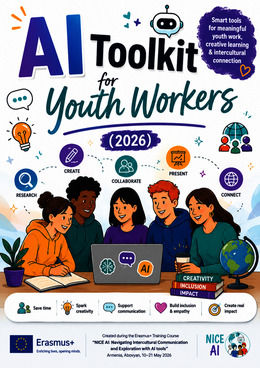
AI Toolkit for Youth Workers (2026)
AI Toolkit for Youth Workers (2026) is a practical guide to AI tools for intercultural learning, role-playing, storytelling, project management, and youth engagement, helping youth workers create more interactive, inclusive, and creative activities.
Aims of the tool
- To enhance youth workers’ digital and AI literacy through practical, accessible tools;
- To support the design and facilitation of engaging non-formal education activities;
- To promote intercultural dialogue, inclusion, empathy, and active participation through AI-assisted learning;
- To provide resources for creating role-plays, simulations, storytelling activities, and creative workshops;
- To improve project planning, communication, content creation, and knowledge management in youth work;
- To encourage the ethical, responsible, and human-centred use of artificial intelligence;
- To inspire innovation and creativity in Erasmus+ projects and other youth initiatives;
- To help youth workers save time on routine tasks and focus more on meaningful learning experiences and participant engagement;
- To offer a curated collection of AI tools that can be directly applied in youth work practice.
Description of the tool
The AI Toolkit for Youth Workers (2026) is a practical resource designed to help youth workers integrate artificial intelligence into non-formal education, intercultural learning, and youth participation activities. It presents a curated selection of AI tools for research, content creation, project management, storytelling, simulations, and creative facilitation, accompanied by QR codes and practical use cases.
Through this toolkit, youth workers can explore innovative ways to design engaging workshops, role-plays, intercultural dialogue activities, and digital learning experiences. The resource promotes the ethical and responsible use of AI while encouraging creativity, inclusion, critical thinking, and active participation among young people.
Learning Outcomes:
- Understand the potential applications of AI in youth work and non-formal education;
- Identify and use AI tools for communication, creativity, facilitation, and project management;
- Design AI-supported learning activities, simulations, and storytelling exercises;
- Apply ethical and responsible approaches to AI use in educational and intercultural contexts.
The Toolkit can be downloaded from the attachment or via the link: https://drive.google.com/file/d/1K0OGuA8iXQpBKbzwz-LypYOfrvVQ7YV2/view?usp=sharing
Available downloads:
Disclaimer
SALTO cannot be held responsible for the inappropriate use of these training tools. Always adapt training tools to your aims, context, target group and to your own skills! These tools have been used in a variety of formats and situations. Please notify SALTO should you know about the origin of or copyright on this tool.
Tool overview
http://toolbox.salto-youth.net/5755
This tool addresses
Project Management, Intercultural Learning, Organisational Management
It is recommended for use in:
Youth Exchanges
Training and Networking
Behind the tool
The tool was created by
The tool was created by participants of the Erasmus+ Training Course "NICE AI: Navigating Intercultural Communication and Exploration with AI tools" 10-21 May 2026 in Armenia, Abovyan
in the context of
The tool was created by participants of the Erasmus+ Training Course "NICE AI: Navigating Intercultural Communication and Exploration with AI tools" 10-21 May 2026 in Armenia, Abovyan
The tool was published to the Toolbox by
Vladimir Kozachun (on 3 June 2026)
and last modified
2 June 2026
Comments
No comments have been posted yet.
If you want to comment on this tool, you need to be signed in with your MySALTO account. Sign in now