Toolbox — For Training and Youth Work
All new tools in your inbox: Be the first to know about new tools for learning with our e-mail notifications.
Manual
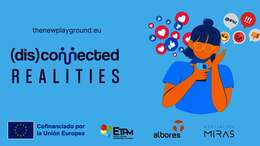
The New Playground: A Guide to Play Safe on Social Media (Dis)connected Realities Project
A practical guide and media kit developed under the (Dis)connected Realities project to support youth workers in promoting safe, critical and healthy use of social media among young people.
Aims of the tool
The (Dis)connected Realities project aims to strengthen digital literacy, critical thinking and online safety among young people by supporting youth workers and professionals with practical tools and resources.
Through the development of “The New Playground” guide and an open-access media kit, the project seeks to raise awareness about the impact of social media on emotional wellbeing, prevent online risks, and promote a conscious, responsible and balanced use of digital environments.
Additionally, the project aims to equip professionals with strategies to identify risky behaviours, address challenges such as cyberbullying, misinformation or digital dependency, and foster safer and more inclusive online spaces for young people.
Description of the tool
“The New Playground: A Guide to Play Safe on Social Media” is one of the main outputs of the Erasmus+ project (Dis)connected Realities.
The guide responds to the growing need for practical resources that help professionals understand and address the challenges young people face in digital environments. It combines research, field experience and multidisciplinary perspectives to offer a comprehensive approach to digital wellbeing.
The concept behind “The New Playground” reflects the idea that social media has become the new space where young people interact, build relationships and shape their identity. As in any playground, it is essential to understand the rules of the game in order to ensure a safe, respectful and healthy environment. This guide aims to support professionals in helping young people navigate these spaces consciously and responsibly.
The content covers key topics such as digital literacy, emotional wellbeing, online risks, identification of harmful behaviours, privacy and security, and positive uses of social media. In addition, it includes practical tools, exercises and strategies that can be directly applied in youth work and educational contexts.
The project was developed by Escola Técnica Profissional da Moita (Portugal), in collaboration with Asociación MIRAS and Asociación Albores (Spain), bringing together expertise from the fields of youth work, education and social intervention.
In addition to the guide, available in English, Spanish and Portuguese to ensure wider accessibility across Europe, the project offers an open-access media kit accessible at www.thenewplayground.eu
, including webinars, short educational videos and additional resources designed to support awareness-raising and training activities.
All materials have been developed with an accessible and practical approach, aiming to be easily transferable to different contexts across Europe. The resources are freely available to ensure long-term impact and to support professionals in promoting a safer and more conscious digital environment for young people.
Project Ref.: 2023-3-PT02-KA210-YOU-000179100
Co-funded by the European Union
Views and opinions expressed are however those of the author(s) only and do not necessarily reflect those of the European Union or the European Education and Culture Executive Agency (EACEA). Neither the European Union nor EACEA can be held responsible for them.
Available downloads:
Disclaimer
SALTO cannot be held responsible for the inappropriate use of these training tools. Always adapt training tools to your aims, context, target group and to your own skills! These tools have been used in a variety of formats and situations. Please notify SALTO should you know about the origin of or copyright on this tool.
Tool overview
http://toolbox.salto-youth.net/5626
This tool addresses
Project Management, Youth Participation
Behind the tool
The tool was created by
Asociación Albores, Asociación Miras and Escola Técnica Profissional da Moita (Portugal)
The tool was published to the Toolbox by
Irene Gallego-Sanabria (on 25 April 2026)
and last modified
25 April 2026
Comments
No comments have been posted yet.
If you want to comment on this tool, you need to be signed in with your MySALTO account. Sign in now