- Training
- Publications
- Resources
- Research
- National Agencies
- Strategic Partnership for Inclusion
- Inclusion and Diversity Strategy
- About SALTO Inclusion & Diversity

Making an Inclusion Strategy
Who should be involved in the process?
You may have heard the expression "two heads are better than one". This is especially true when it comes to strategy development.
Each National Agency has a designated Inclusion Officer who is generally responsible for monitoring all inclusion-related issues. When it comes time to develop an inclusion strategy, the task is often delegated to the Inclusion Officer but this can be a risky approach. It is neither effective nor realistic for an Inclusion Officer to try to make a strategy on their own. Not only is there simply too much work involved but if the inclusion strategy is developed in isolation (on a one-person basis) there is a good chance that the end result will clash with other aspects of the NA's strategy. There is also a very strong possibility that the rest of the team will resist implementing the action steps because they were not involved in the overall development of the plan.
Including other people and their points of view in the strategy development process means that your strategy will have a stronger foundation. It will also increase people's feeling of ownership for the resulting action plan. If people feel that they were able to make an active contribution in the early stages, they are far more likely to take responsibility for implementing the plan and action steps over the long term.
Of course you don't want to slow down the process by having too many players in the game. It is important to identify your key stakeholders.
National Agencies should consider including the National Authority
as a contributor to their strategy development.
This can help ensure that different offices
are working in unison
rather than in conflict with one another.
^^ top ^^
Stakeholders
A stakeholder is anyone who has an interest in or who might be impacted by your strategy.
There are two main groups of stakeholders:
- Internal stakeholders - are people inside your organisation whose tasks will be impacted by your strategy. Internal stakeholders in the National Agency could include the Project Officers in each separate Action, the Inclusion Officer, the selection committee, contacts in the regional offices and the Head of the Agency. Remember that not everyone in your office should automatically be considered as a stakeholder - only those who will be most affected by your plans and those who will make the biggest contribution to the strategy-making process.
- External stakeholders - are people (individuals, groups or entire organisations) who will be affected by your strategy and who can (or want) to influence the future of your organisation. External stakeholders for National Agencies could include project promoters, local/regional/national authorities, trainers, and of course the young people themselves.
These are just some examples. Clearly it is not possible to involve every one of these individuals and/or groups in your strategy-making process. The reality of inclusion work inside an NA is that there is little time or manpower available so when it comes to developing strategy it is crucial to identify a short list of key stakeholders.
Your key stakeholders are the people who need to be actively involved in making your strategy because they are in some way crucial to the success of your plan. It is in your best interest to implicate these key players in your strategy development whenever possible.
^^ top ^^
The strategy team
Your key stakeholders will play an important role in contributing information and different points of view but they are not the ones who will make the final decisions nor will they be responsible for the day-to-day implementation of your strategy. For this, you need to set up a strategy team.
The strategy team is a core group of people who are responsible for gathering information and making choices in the early stages and for implementing, monitoring and evaluating the action steps in the later stages. The strategy team will likely be made up mostly of internal stakeholders, but if possible it is a good idea to include a small number of external stakeholders as well.
Some NAs have well-established strategy teams while others have no defined team at all. Two examples of inclusion strategy teams can be seen here below:
- Example 1 - France
INJEP pioneered the idea of establishing a national-level working group on inclusion. In the past, this working group was instrumental in developing inclusion strategy. The group has traditionally been made up of 10 persons, all from inside the programme (representatives from youth organisations, local municipalities, trainers). The group met twice per year and worked together with the Inclusion Officer and 1-2 representatives from the regional offices.
Bringing stakeholders together in a working group encouraged organisations to co-operate rather than to compete. The group also ensured that the grass-roots level was represented in the strategy making process and not just the view of the central Paris office.
- Example 2 - Belgium (Flanders)
JINT has established an internal "sub-team" on inclusion. The sub-team totals 7 persons and is made up of colleagues from the NA (including the Inclusion Officer and a member of the director's team) as well as representatives from other national programmes. The group meets once every 5 weeks.
The internal sub-team works closely with a group of external experts who are requested to give their advice and expertise to develop a mission, vision and strategy on inclusion. The expert group meets once every 2-3 months.
The two groups communicate intensively and "fertilise" each other. Their advice is discussed and immediately implemented into JINT's work. In this way, their efforts are immediately valued.
^^ top ^^
National-level working groups or strategy teams may not be an option for all NAs. It is perfectly acceptable to have a strategy team made up entirely of NA staff (particularly in smaller offices) but it is very helpful to include at least one or two external stakeholders if possible.
No matter what the size or composition of the strategy team, it is a good idea to involve the Head of the National Agency whenever possible. It is the director's task to ensure that the inclusion strategy links in with the rest of the National Agency's activities. Any strategy developed by the team must have the director's approval if it is to be put into practice. This does not mean that the director needs to attend every meeting of the strategy team but they do need to be kept informed of developments as the strategy takes shape.
The composition of the rest of the strategy team will depend on the size of the NA, its current level of involvement in inclusion work, its ambitions for the future and of course its financial means. When choosing potential members of the team, consider the different tasks that need to be done in the different phases (information gathering, prioritising, monitoring, evaluating, etc.) and try to match them with the right personalities. Strive for a mix in the team between "controllers" (who want everything worked out in detail) and "free spirits" (who prefer to see "the big picture").
Large or small, the strategy team must remember that the direction of an inclusion strategy will affect the entire NA so it is important to regularly update colleagues outside of the team on the plans.
^^ top ^^
What does the process look like?
As stated earlier, strategy-making is made up of four distinct phases: Analysis, Planning, Implementation and Evaluation. Each of these phases can be broken down into smaller steps which make the process easier to manage and which make it easier for you to see progress being made (see the diagram below or download the diagram here)
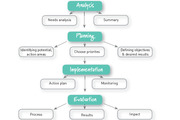
Each person involved in inclusion in the NA will be impacted by the different phases but the main responsibility for steering and guiding the process rests with the strategy team.
As you go deeper into strategy-making you will see that while some of the steps need to be carried out in a particular order other steps are less systematic and may overlap considerably. It is quite normal to be busy with two or even three phases at the same time. Do not become too pre-occupied by the order of the steps. Concentrate instead on moving the process forward as best you can.
The next sections outline what is involved in each phase and describe methods that NAs can use to help them move through the different steps.
^^ top ^^