- Training
- ESC training
- ESC Quality Label
- Info Centres
- Publications
- Social media
- About SALTO EECA Resource Centre

Ukraine
| Full country name | Ukraine |
| Capital | Kyiv |
|
Area |
603,628 km2 |
|
Administrative divisions |
The 24 oblasts and Crimea are subdivided into 136 raions (districts) and city municipalities of regional significance, or second-level administrative units. |
|
Population |
41,362,393 (excluding Crimea and Sevastopol, 2021 census) |
| Ethnic groups | 77.8% Ukrainians 17.3% Russians 4.9% others/unspecified |
|
Religion |
87.3% Christianity 11.0% Irreligion 0.8% Others 0.9% Unanswered |
|
Language |
Ukrainian |
|
Currency |
Hryvnia (₴) (UAH) |
|
Government type |
Unitary semi-presidential constitutional republic |
|
President |
Volodymyr Zelensky |
|
Human Development Index |
0.779 | 74th |
| View Full Source | Wikipedia |
Ukraine, country located in eastern Europe, the second largest on the continent after Russia. The capital is Kyiv (Kiev), located on the Dnieper River in north-central Ukraine.
A fully independent Ukraine emerged only late in the 20th century, after long periods of successive domination by Poland-Lithuania, Russia, and the Union of Soviet Socialist Republics (U.S.S.R.). Ukraine had experienced a brief period of independence in 1918–20, but portions of western Ukraine were ruled by Poland, Romania, and Czechoslovakia in the period between the two World Wars, and Ukraine thereafter became part of the Soviet Union as the Ukrainian Soviet Socialist Republic (S.S.R.). When the Soviet Union began to unravel in 1990–91, the legislature of the Ukrainian S.S.R. declared sovereignty (July 16, 1990) and then outright independence (August 24, 1991), a move that was confirmed by popular approval in a plebiscite (December 1, 1991). With the dissolution of the U.S.S.R. in December 1991, Ukraine gained full independence. The country changed its official name to Ukraine, and it helped to found the Commonwealth of Independent States (CIS), an association of countries that were formerly republics of the Soviet Union.
Source : Britannica
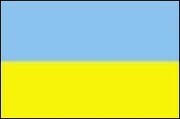
Flag of Ukraine
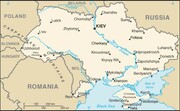 Map of Ukraine