- Recognition of Non-Formal Learning
- Youthpass
- European Training Strategy
- Trainers
- Youth Workers
- Stakeholder Cooperation
- National Agencies
- About SALTO T&C RC

European Training Strategy (ETS)
Welcome to the European Training Strategy space!
We recognise youth workers, trainers and National Agencies (NA) to be key stakeholders in the implementation and quality development of the EU youth Programmes at European and national levels. In an ever-developing world, they must be prepared and equipped to sense, face, address and respond to trends and opportunities for change.
The European Training Strategy (ETS) was first introduced in the frame of the YOUTH Programme (2000-2006) and amended under the Youth in Action Programme (2007-2013). Building on the former revisions, the latest version of the strategy is focusing on sustaining capacity building and educational pathways for youth workers through competence-based approaches to the education and training of paid and volunteer youth workers.
The aim of the ETS is to build a cooperation framework, strengthen the connection to recognition and validation mechanisms and support systemic change on all levels: micro, meso and macro.
Its desired impact is on offering consolidated approaches in youth work training, and on supporting them, though four strategic directions:
- Support for and steering institutional cooperation at the European level;
- A comprehensive system to support European and international trainers’ professional development;
- Recognition of the youth worker profession and validation of their competence development and learning outcomes (read more about Youthpass here)
- Innovation for quality in youth work with a focus on youth worker education and training.
Built on the common ground of the European youth work, through joined forces, co-creation and collaboration, the ETS encourages the use of the immense work already done in the community of practice. It suggests the actors involved to focus on a systemic and sustained impact, from offering consolidated approaches in youth work training to a world where the value and the contribution of youth work is properly recognised.
The ETS aims to have competence as a basis on which to prepare and support the youth workers and trainers, as well as the staff of the National Agencies of the EU Youth Programmes, who will have systematised guidance when it comes to their professional development, as well as proper support and appropriate investment.
Through it’s focus on the European dimension of youth work, the strategy looks at the links between the European and national levels and contributes to closing gaps in the national contexts, aiming to support and contribute to existing national processes and have networking, cooperation and sharing good practices be the prerequisites to foster appropriate development of youth work in Europe and beyond.
Its success can be monitored through achieving the following goals:
- Complement the efforts of the European Youth Work Agenda;
- Support the National Agencies;
- Develop a comprehensive quality assurance system for trainers;
- Establish a voluntary certificate and recognition scheme for trainers;
- Develop modular courses for youth workers;
- Ensure the validation of youth workers’ competences;
- Create and support pilot initiatives & innovative approaches.
When it comes to a competence-based approach, the ETS refers to three main documents:
- For youth workers: ETS Competence Model for Youth Workers to Work Internationally
- For trainers in the field of youth: ETS Competence Model for Trainers
- For the staff of the National Agencies: the KMST Competence Framework
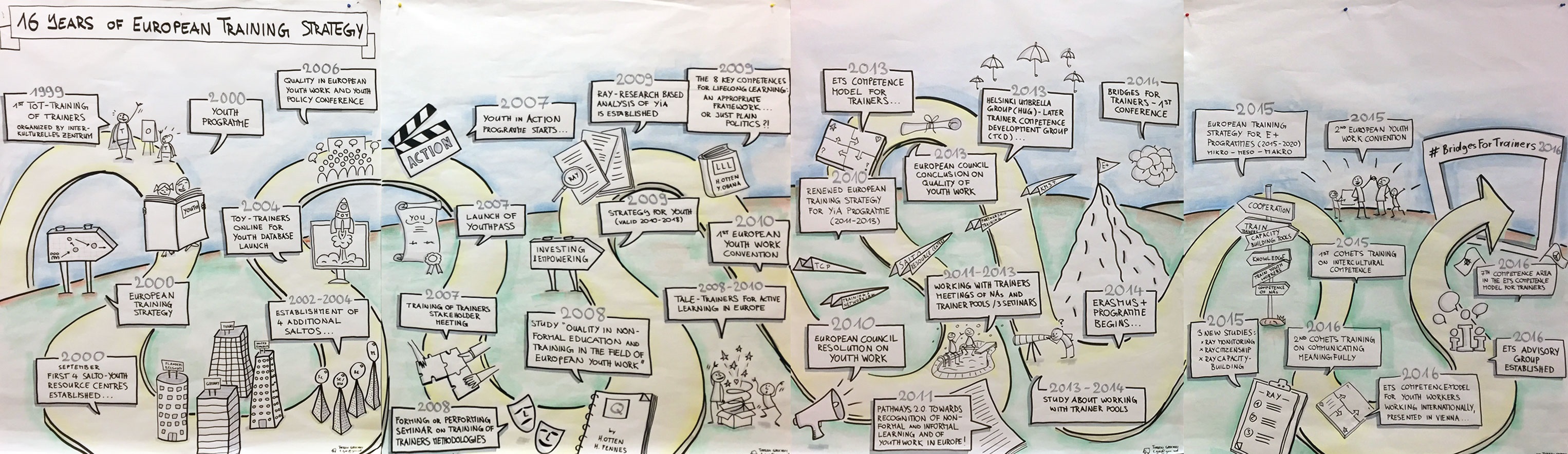
To reach the current version of the strategy, the contribution of many people and processes has to be recognised. Would you care to join us on a walk down the memory lane? See below a graphic recording of the most important milestones in the last two decades, since the idea was first introduced: