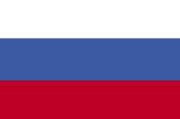
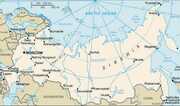
Russia is a country that stretches over a vast expanse of Eurasia. With an area of 17,075,200 square kilometres, it is the largest country in the world by land mass, covering almost twice the territory of the next-largest country, Canada. It ranks as the world's eighth largest population. Russia shares land borders with the following countries: Norway, Finland, Estonia, Latvia, Lithuania, Poland, Belarus, Ukraine, Georgia, Azerbaijan, Kazakhstan, China, Mongolia and North Korea. It is also close to the United States (Alaska), Canada, Turkmenistan, Iran, Turkey, Sweden, and Japan across relatively small stretches of water.
Founded in the 12th century, the Principality of Muscovy, was able to emerge from over 200 years of Mongol domination (13th-15th centuries) and to gradually conquer and absorb surrounding principalities. In the early 17th century, a new Romanov Dynasty continued this policy of expansion across Siberia to the Pacific. Under PETER I (ruled 1682-1725), hegemony was extended to the Baltic Sea and the country was renamed the Russian Empire. During the 19th century, more territorial acquisitions were made in Europe and Asia. Repeated devastating defeats of the Russian army in World War I led to widespread rioting in the major cities of the Russian Empire and to the overthrow in 1917 of the imperial household. The Communists under Vladimir LENIN seized power soon after and formed the USSR. The brutal rule of Iosif STALIN (1928-53) strengthened communist rule and Russian dominance of the Soviet Union at a cost of tens of millions of lives. The Soviet economy and society stagnated in the following decades until General Secretary Mikhail GORBACHEV (1985-91) introduced glasnost (openness) and perestroika (restructuring) in an attempt to modernize Communism, but his initiatives inadvertently released forces that by December 1991 splintered the USSR into Russia and 14 other independent republics. Since then, Russia has struggled in its efforts to build a democratic political system and market economy to replace the strict social, political, and economic controls of the Communist period.
The 1990s were plagued by armed ethnic conflicts in the North Caucasus. Such conflicts took a form of separatist insurrections against federal power (most notably in Chechnya), or of ethnic/clan conflicts between local groups (e.g., in North Ossetia-Alania between Ossetians and Ingushs, or between different clans in Chechnya). Recently the situation is slowly stabilized.
As of 2005 Russia has 13 cities with over a million inhabitants (from largest to smallest): Moscow, Saint Petersburg, Novosibirsk, Yekaterinburg, Nizhny Novgorod, Samara, Omsk, Kazan, Chelyabinsk, Rostov-on-Don, Ufa, Volgograd and Perm.
The most widespread religion in Russia is Orthodox Christianity dominated by Russian Orthodox Church. A considerable portion of the population considers themselves atheists, since several generations lived through the time of suppression of religion in the Soviet Union. Still, a significant part of atheists associates themselves culturally with the Russian Orthodoxy.
Russian is the most widely spoken language of Eurasia and the most widespread of the Slavic languages. It is one of the six official languages of the United Nations.
Source: Wikipedia, the free encyclopedia. You can read full article here!
Basic information
Full country name: Russian Federation
Government type: Federation republic
Capital: Moscow
Independence: 24 August 1991 (from Soviet Union)
National holiday: Russia Day, 12 June (1990)
Area: 17.07 million sq km
Administrative divisions: 49 oblasts (oblastey, singular - oblast), 21 republics (respublik, singular - respublika), 10 autonomous okrugs (avtonomnykh okrugov, singular - avtonomnyy okrug), 6 krays (krayev, singular - kray), 2 federal cities (singular - gorod), and 1 autonomous oblast (avtonomnaya oblast')
Population: 140,041,247 (July 2009 est.)
Ethnic groups: Russian 79.8%, Tatar 3.8%, Ukrainian 2%, Bashkir 1.2%, Chuvash 1.1%, other or unspecified 12.1% (2002 census)
Language: Russian - official, many minority languages
Religion: Russian Orthodox, Muslim, Buddhism, Rome-Catholic, other
GDP - per capita: $15,800 (2008 est.)
Labor force - by occupation: agriculture: 10.2%, industry: 27.4%, services: 62.4% (2007 est.)
Unemployment rate: 6.2% (2008 est.)
Population growth rate: -0.467% (2009 est.)
Source: The World Factbook. You can read full article here!