- EuroMed Training Opportunities
- EuroMed Educational publications
- SALTO EuroMed Educational Tools
- ESC South-Med
- EVS Resources and background material
- About SALTO-YOUTH EuroMed
TRAINING SEMINAR: “LET’S MEET THE THREE CULTURES” - 4th. Edition

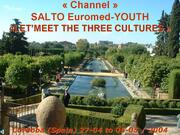

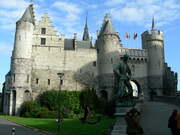
check past training courses
Cordoba 2004 - Jerusalem 2005 - Antwerp 2006
BACKGROUND
The event is co-organised with the French National Agency of the Youth In Action programme.
The three cultures, Christianism, Islam and Judaism, have been present in Europe since early times. Europe today reflect the rich and intrinsic relations between the cultures along the times, showing in itself meeting points as well as the result of conflicts along the years.
Paris, standing in the geographical and cultural middle of the continent, represents at the same time those cultures, within a society which strives for a constant secularism.
SPECIFICITY OF THE VENUE
The symbol of the city of Paris and its rich multicultural history and its communities will be used as an educational tool. More than ever before, Paris of the 21st century is a feisty brew of peoples from around the world. Old-fashioned French flavours have not been lost, or even submerged - men in berets still play boules on the quai de la Seine, and bourgeois Madames still feed tasty titbits to their poodles from the restaurant table. But there are more ingredients in the city mix, more viewpoints. It is estimated that 20% of the two million people living in central Paris are immigrants. In the North African strongholds of Belleville and La Goutte d'Or, men in bars sup sugary mint tea and puff on water pipes. Restaurants serve couscous, tagine and sticky pastries against a background of raï music.
DATES
From Saturday October 27th., 2007 between 16:00-20:00 (arrival day), till Sunday, November 4th., 2007 by 9:00 (departure day).
AIM
To develop Euro Mediterranean cooperation, reinforcing the quality of the EuroMed YOUTH Programme within an intercultural context, increasing the participants' skills in EuroMed cultures (not cultural management) and their active participation in the Euro Mediterranean process.
OBJECTIVES
- To know EuroMed cultures and their relation with the Christianism, Islam and Judaism.
- To reflect on the participants' own cultural identity.
- To identify the common elements in relation with the other cultures.
- To reflect on the place of secularism in EuroMed societies.
- To be able to create together using the past to prepare a better future.
- To prepare the framework and coach the participants in the realisation of concrete partnerships within the EuroMed YOUTH Programme.
MAIN FEATURES
Intercultural activities will be organized using different techniques and methods linked to communication tools like: languages, arts forms, food, traditions, (advertising), as well as using the five senses.
Activities will be organized using different techniques and methods linked to verbal and non-verbal communication.
Each group will work in its own topic, in relations to the three cultures and the place of secularism. Each group will have to research, develop and deliver a two-hour non-formal education acitivity to the rest of the group, which has a transferable charachteristic to be later implemented practically with youth within the EuroMed region.
Participants will have to research about the topic, how it was in the past; and they will have to prepare and organise one active performance to provide these discoveries to other participants; each topic needs to be crossed by two themes: the place of the women and the religion, in each of these four topics in the past, in order to be used during a debriefing and to reflect on today's reality.
ADDITIONAL PROGRAMME ELEMENTS
- Why EuroMed (cooperation) projects?
- Communication and group dynamics.
- Christianity, Islam and Judaism within EuroMed.
- The place of secularism in EuroMed societies and its relation with the three cultures.
- Definitions of culture, multiculturalism and interculturalism.
- Intercultural awareness.
- International teamwork.
- Evaluation.
- Planning of follow-up.
Profile of participants
The course is intended to be an opportunity for further training for youth workers and youth leaders who:
- are experienced in the Youth field and familiar with this topic;
- are open to enrich their knowledge and awareness regarding the other cultures;
- are committed to prepare themselves for the above-mentioned subjects, previous to their arrival and to do the remote work requested by the team in case of selection;
- are motivated to undergo training and able to attend the course for its full duration;
- are supported by their organisation and have green light for implementing a Euro-Med YOUTH project;
- are able to communicate and work in at least one of the two working languages of this training course (English and French)
- are residents in a European Union Member State or in a Mediterranean Partner country signatory to the Barcelona Declaration.
Please note that "online application" completion is a compelling requirement to be accepted to the pre-selection process!
Once pre-selected, candidates will be provided with more specific documents linked to this training activity which must be sent back to the Salto Youth EuroMed Resource Centre.
Final selection will be based on the quality of these documents!
PREPARATORY WORK IN CASE OF SELECTION:
(Please, consider this preparation work as a necessary part of the training-course)
- Bring at least one element of the "other" two cultures (either Christianism, Islam or Judaism) that exist in your own country. The elements could be any object that reflects the cultural heritage and/or patrimony. Try to bring elements that are less known from each culture.
- Refresh your knowledge about the YOUTH IN ACTION & EUROMED YOUTH programmes by reading the EuroMed User's Guide.
- Bring Ideas for energisers and evening game.
- Bring materials about your own country (maps, pictures, brochures, video, DVD, etc.).
- Bring materials about your own organization (brochures, posters, video, DVD, etc.).
- For the intercultural evening:
o Food and/or drinks
o Music, dance, poetry (to be shown or taught)
o Traditional costumes
- A short poem written in your original language and translated, at least, to one of the TC languages.
- Optional: technical equipment - Laptop, Digital Camera (including CD driver and cables), CD player, MP3 player, memory stick.