Toolbox — For Training and Youth Work
All new tools in your inbox: Be the first to know about new tools for learning with our e-mail notifications.
Simulation Exercise, Exercise, Presentation, Group Building Activity
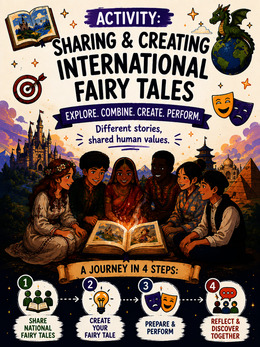
Weaving Worlds Together: Creating Intercultural Fairy Tales
Explore folklore fairy tales from different cultures, identify shared values and unique traditions, then collaboratively create, enhance (with AI), and perform an intercultural fairy tale through storytelling, role-play, and reflection.
Aims of the tool
- Explore folklore fairy tales as reflections of cultural identity, values, and traditions;
- Promote intercultural learning through the sharing and comparison of stories from different cultures;
- Identify common themes, archetypes, symbols, and moral values found across cultures;
- Foster appreciation of both cultural diversity and shared human experiences;
- Develop storytelling, creative writing, and narrative-building skills;
- Encourage collaborative creation of intercultural fairy tales that combine elements from multiple traditions;
- Introduce participants to the Hero’s Journey, Story Arc and basic storytelling structures;
- Strengthen communication, teamwork, creativity, and critical thinking;
- Explore the use of AI tools to support storytelling, script development, and creative expression;
- Enhance role-play, performance, and experiential learning skills;
- Encourage reflection on how folklore can support intercultural dialogue, youth work, and non-formal education;
- Demonstrate that, despite cultural differences, many fairy tales are rooted in universal human values and principles.
Description of the tool
"Weaving Worlds Together: Creating Intercultural Fairy Tales" is an experiential learning activity that uses folklore, storytelling, role-play, and AI-supported creativity to promote intercultural learning and dialogue. Participants begin by sharing traditional fairy tales from their cultures, exploring their plots, characters, symbols, archetypes, values, and moral messages. Through guided discussion, they identify both cultural specificities and recurring patterns found in fairy tales across the world.
Working in intercultural groups, participants then create an original international fairy tale that combines elements from the stories shared within their group. Using storytelling frameworks such as the Hero's Journey and Story Arc, they collaboratively develop characters, conflicts, settings, and narratives that reflect both shared human values and unique cultural traditions. AI tools may be used to support idea generation, script development, dialogue writing, language adaptation, and visual creation.
The activity culminates in the preparation and performance of the newly created fairy tales, followed by structured reflection and debriefing. Through storytelling, role-play, performance, and collective analysis, participants gain a deeper understanding of how folklore reflects culture while also revealing universal human experiences and values.
Learning Outcomes
Participants will:
- Explore folklore fairy tales as expressions of cultural identity, traditions, beliefs, and values;
- Develop intercultural awareness through sharing and comparing stories from different cultures;
- Identify common archetypes, symbols, themes, and narrative patterns across cultures;
- Recognize shared human values reflected in diverse cultural traditions;
- Strengthen storytelling, creative writing, and narrative-building skills;
- Learn to apply basic storytelling frameworks such as the Hero's Journey and Story Arc;
- Enhance creativity, imagination, and collaborative problem-solving abilities;
- Improve communication, active listening, discussion, and presentation skills;
- Develop role-play, performance, and theatrical expression competencies;
- Gain practical experience in using AI tools to support storytelling and creative processes;
- Foster empathy and perspective-taking by engaging with different cultural narratives;
- Strengthen teamwork, cooperation, and group decision-making skills;
- Reflect on the use of storytelling and folklore as tools for intercultural dialogue and youth work practice.
Facilitator's Tips:
1) For a deeper understanding of the narrative frameworks used in this activity, explore "The Journey of Transformation: Story Arc & Hero's Journey Framework", which introduces the Hero's Journey, Story Arc, character development, and transformational storytelling principles that underpin this practice.
-> Available at: http://toolbox.salto-youth.net/5758
2) To further explore practical methods for story creation and immersive performance, see "Storytelling & Role-Play Practice (Story Arc & Hero's Journey Framework)".
-> Available at: http://toolbox.salto-youth.net/5760
Disclaimer
SALTO cannot be held responsible for the inappropriate use of these training tools. Always adapt training tools to your aims, context, target group and to your own skills! These tools have been used in a variety of formats and situations. Please notify SALTO should you know about the origin of or copyright on this tool.
Tool overview
http://toolbox.salto-youth.net/5762
This tool addresses
Intercultural Learning, Personal Development, Peer education, Youth Participation
It is recommended for use in:
Youth Exchanges
Training and Networking
Behind the tool
The tool was created by
Vladimir Kozachun
in the context of
Erasmus+ Training Course "NICE AI: Navigating Intercultural Communication and Exploration with AI tools" 10-21 May 2026 in Armenia, Abovyan
The tool was published to the Toolbox by
Vladimir Kozachun (on 9 June 2026)
and last modified
7 June 2026
Comments
No comments have been posted yet.
If you want to comment on this tool, you need to be signed in with your MySALTO account. Sign in now