Toolbox — For Training and Youth Work
All new tools in your inbox: Be the first to know about new tools for learning with our e-mail notifications.
Simulation Exercise, Exercise
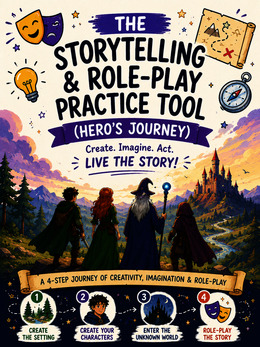
Storytelling & Role-Play Practice (Story Arc & Hero's Journey Framework)
"Storytelling & Role-Play Practice" is an experiential learning tool that helps participants co-create immersive stories, develop characters, explore emotions, and practice role-play through imagination, collaboration, and creative storytelling.
Aims of the tool
- Develop participants’ storytelling and creative expression skills;
- Strengthen imagination, spontaneity, and role-play competencies;
- Enhance communication, active listening, and collaboration in groups;
- Foster empathy by encouraging participants to explore different characters, emotions, and perspectives;
- Promote experiential and non-formal learning through immersive storytelling;
- Increase confidence in self-expression, improvisation, and public performance;
- Encourage deeper engagement with narratives through sensory and emotional exploration;
- Support intercultural learning by creating space for diverse interpretations, experiences, and viewpoints;
- Improve participants’ ability to create meaningful characters, settings, and storylines;
- Help participants experience the Story Arc and Hero’s Journey as a practical framework for storytelling and personal development.
Description of the tool
Storytelling & Role-Play Practice (Story Arc & Hero's Journey Framework) is an experiential learning tool that develops storytelling, creativity, communication, and role-play skills through collaborative story creation and immersive acting. Working in small groups, participants build a story step by step by creating a setting, developing characters, exploring challenges, and role-playing key moments inspired by the Hero’s Journey and Story Arc.
Using sensory imagination ("I see", "I hear", "I feel"), the improvisational principle of "Yes, and…", and embodied role-play, participants deepen their engagement with the narrative, emotions, and group interaction. The focus is not on finishing the story, but on experiencing it fully and bringing it to life through imagination, expression, and collaboration.
The tool is suitable for youth work, non-formal education, intercultural learning, theatre-based activities, language learning, team building, and personal development.
Learning Outcomes
Participants will:
- Develop storytelling and narrative-building skills;
- Strengthen creativity, imagination, and improvisation;
- Improve communication, active listening, and collaboration;
- Practice character creation and role-play techniques;
- Increase empathy and emotional awareness through perspective-taking;
- Build confidence in self-expression and performance;
- Learn to create engaging settings, characters, and conflicts;
- Experience experiential and non-formal learning methods;
- Strengthen teamwork and collective creativity;
- Gain practical understanding of the Hero’s Journey and Story Arc frameworks.
Facilitator's Tip:
For a deeper understanding of the narrative frameworks used in this activity, facilitators are encouraged to explore our companion tool, "The Journey of Transformation: Story Arc & Hero's Journey Framework". It provides a comprehensive introduction to the Hero’s Journey, Story Arc, character development, and transformational storytelling principles that support this practice.
-> Available at: http://toolbox.salto-youth.net/5758
Available downloads:
Disclaimer
SALTO cannot be held responsible for the inappropriate use of these training tools. Always adapt training tools to your aims, context, target group and to your own skills! These tools have been used in a variety of formats and situations. Please notify SALTO should you know about the origin of or copyright on this tool.
Tool overview
http://toolbox.salto-youth.net/5760
This tool addresses
Intercultural Learning, Personal Development, Youth Participation
It is recommended for use in:
Youth Exchanges
Training and Networking
Behind the tool
The tool was created by
Vladimir Kozachun
in the context of
Erasmus+ Training Course "NICE AI: Navigating Intercultural Communication and Exploration with AI tools" 10-21 May 2026 in Armenia, Abovyan
The tool was published to the Toolbox by
Vladimir Kozachun (on 9 June 2026)
and last modified
6 June 2026
Comments
No comments have been posted yet.
If you want to comment on this tool, you need to be signed in with your MySALTO account. Sign in now